Friday, May 25, 2018

For your eyes only: A short history of Democrat-spy collusion

Part 2, kinda...

For your eyes only: A short history of Democrat-spy collusion
Roger Kimball, Spectator USA

How highly placed members of one administration mobilized the intelligence services to undermine their successors.

Who what where when why? The desiderata school teachers drill into their charges trying to master effective writing skills apply also in the effort to understand that byzantine drama known to the world as the Trump-Russia-collusion investigation.

Let’s start with “when.” When did it start? We know that the FBI opened its official investigation on 31 July 2016. An obscure, low-level volunteer to the Trump campaign called Carter Page was front and centre then. He’d been the FBI’s radar for a long time. Years before, it was known, the Russians had made some overtures to him but 1) they concluded that he was an “idiot” not worth recruiting and 2) he had actually aided the FBI in prosecuting at least two Russian spies.

But we now know that the Trump-Russia investigation began before Carter Page. In December 2017, The New York Times excitedly reported in an article called “How the Russia Inquiry Began” that, contrary to their reporting during the previous year, it wasn’t Carter Page who precipitated the inquiry. It was someone called George Papadopoulous, an even more obscure and lower-level factotum than Carter Page. Back in May 2016, the twenty-something Papadopoulous had gotten outside a number of drinks with one Alexander Downer, an Australian diplomat in London and had let slip that “the Russians” had compromising information about Hillary Clinton. When Wikileaks began releasing emails hacked from the Democratic National Committee in June and July, news of the conversation between Downer and Papadopoulos was communicated to the FBI. Thus, according to the Times, the investigation was born.

There were, however, a couple of tiny details that the Times omitted. One was that Downer, an avid Clinton supporter, had arranged for a $25 million donation from the Australian government to the Clinton Foundation. Twenty-five million of the crispest, Kemo Sabe. They also neglected say exactly how Papadopoulos met Alexander Downer.

As it turns out, George Papadopoulos made several new friends in London. There was Joseph Mifsud, a Maltese professor living in London who has ties to British intelligence. It was Mifsud—who has since disappeared—who told Papadopoulos in March 2016 that the Kremlin had “dirt” on Hillary Clinton.

Then there is Stefan Halper, an American-born Cambridge prof and Hillary supporter. Out of the blue, Halper reached out to Papadopoulos in September 2016. He invited him to meet in London and then offered Papadopoulos $3,000 to write a paper on an unrelated topic. He also pumped him about “Russian hacking.” “George, you know about hacking the emails from Russia, right?” Halper is said to have asked him. He also made sure Papadopoulos met for drinks with his assistant, a woman called Azra Turk, who flirted with him over the Chardonnay while pumping him about Russia.

Halper also contacted Carter Page and Sam Clovis, Trump’s campaign co-chair. Is Stefan Halper, the “spy” on the Trump campaign, at the origin of the Trump-Russia meme?

Not really. The real fons et origo is John Brennan, Director of the CIA under Obama. As Trump’s victories in the primaries piled up, Brennan convened a “working group” at CIA headquarters that included Peter Strzok, the disgraced FBI agent, and James Clapper, then Director of National Intelligence, in order to stymie Trump’s campaign.

So much of this story still dwells in the tenebrous realm of redaction. But little by little the truth is emerging, a mosaic whose story is gradually taking shape as one piece after the next completes now this face, now another.

There are details yet to come, but here is the bottom line, the irreducible minimum. A cabal of CIA and FBI operatives, including the Director of the CIA, John Brennan, along with other members of the intelligence “community,” prominently including James Clapper, Director of National Intelligence, and various members of the Obama administration, colluded to undermine Donald Trump’s campaign.

Like almost everyone else, they assumed that Hillary Clinton was a shoo-in, so they were careless about covering their tracks. If Hillary had won, the department of Justice would have been her Department of Justice, John Brennan would still be head of the CIA, and the public would never have known about the spies, the set-ups, the skulduggery.

But Hillary did not win. For the last 16 months, we’ve watched as that exiled cabal shifted its efforts from stopping Trump from winning to a desperate effort to destroy his Presidency. Thanks to the patient work of Devin Nunes, Chairman of the House Intelligence Committee, and a handful of GOP Senators, that effort is now disintegrating. What is being exposed is the biggest political scandal in the history of the United States: the effort by highly placed—exactly how highly placed we still do not know—members of one administration to mobilise the intelligence services and police power of the state to spy upon and destroy first the candidacy and then, when that didn’t work, the administration of a political rival.

It is banana republic behaviour, but it looks now as if those responsible for this effort to undermine American democracy and repeal the results of a free, open, and democratic election will be exposed. Let’s hope that they are also held to account.

Monday, May 21, 2018

How Democracies End: A Bureaucratic Whimper


How Democracies End: A Bureaucratic Whimper
Victor Davis Hanson, American Greatness

This is the way the world ends, Not with a bang but a whimper. ― T.S. Eliot

One strange trait of the die hard NeverTrump Republicans and progressives is their charge that Donald Trump poses an existential threat to democracy. Trump, as is his wont, says a lot of outrageous and weird things. But it is hard in his 16 months of rule to find any proof that Trump has subverted the rule of law.

Most of the furor is over what we are told what Trump might do, or what Trump has said, or which unsavory character in Europe likes Trump. These could be legitimate worries if they were followed by Trump’s anti-democratic concrete subversions. But so far, we have not seen them. And there has certainly been nothing yet in this administration comparable to the Obama-era efforts to curb civil liberties.

While we understand those on the left refuse to believe that a constitutional “legal scholar” like Obama would even think of allowing the executive branch to go rogue, it is indeed strange that in almost every NeverTrump attack on Trump’s conduct, there is almost no recognition or indeed worry that we have been living through one of the great challenges to constitutional government in our history.

Does anyone remember that the Obama Administration allowed Lois Lerner (“Not a smidgen of corruption”) more or less to weaponize the IRS to help the Obama 2012 reelection effort? Does anyone remember Eric Holder’s surveillance of the Associated Press journalists and Fox News’s James Rosen? Why have conservative constitutionalists focused on what Trump has said rather than the strange treatment accorded to investigative reporter Sharyl Attkisson by U.S. intelligence and investigatory agencies? Do we even remember the Benghazi pseudo-video narrative and the strange jailing of Nakoula 

Is there even curiosity about why and how the departing Obama Administration suddenly and vastly expanded the number of agencies that could have access to classified surveillance in its aftermath? Do we remember the more than 20 times Obama warned before reelection that he was not a “king” and, as a constitutional scholar, could not by fiat offer blanket amnesties? Do the authorities in California realize that they are resorting to the extralegal states-rights arguments that South Carolina on the eve of the Civil War and Alabama in the early 1960s used to nullify federal laws?

But stranger still is what we already know of the 2016 election, and the lack of outrage from constitutionalists, who daily warn us of what Trump might do—when we already know what the U.S. government has done in violation of civil rights, constitutional principles, and likely federal laws. So far there is no information that Stephen Bannon ordered taps on reporters, or that Nigel Farage was hired by Trump to find Russian dirt on Hillary Clinton, or that Stephen Miller requested the unmasking of surveilled names associated with the Clinton campaign and then leaked them to the press.

But we do know that U.S. officials, including the head of the FBI and chief deputies in the Justice Department, misled a FISA court to obtain intelligence surveillance on U.S. citizens, by providing information that they knew at the time, but did not disclose to the court, was by their own private admission unverified, compiled by a foreign national whom they had used and fired as an unreliable informant, paid for by the Clinton campaign, and served as the basis for news accounts that were used in circular fashion to verify to the court the dossier’s contents.

We do know that members of the Obama intelligence and national security teams—Susan Rice and Samantha Power among others—requested the names of American citizens surveilled (likely obtained through improperly obtained FISA warrants) to be unmasked. Then someone illegally leaked their names to the press to damage the Trump campaign and his presidential transition.

We do know that FBI Director James Comey, in succession, has admitted that he in singular fashion took notes of a confidential one-on-one meeting with the president, briefed him on the existence of a campaign dossier on him, did not disclose that it was purchased by the Clinton campaign, assured him that he was not the subject of a FBI investigation at a time either he or his subordinates were leaking the opposite to the media, and then, after being fired, leaked those memos (at least one of which was classified) to the media to ensure the appointment of a special counsel to investigate the president, who turned out to be a friend of Comey’s, Robert Mueller. Comey by his own admission has also stated that he calibrated the FBI investigation of Hillary Clinton to the likelihood of her election to the presidency. FBI directors in a lawful society are not supposed to do such things.

We do know that the FBI placed some sort of an informant in the camp of Donald Trump’s 2016 campaign in association with gathering information about data used by a foreign national and a paid operative of the Clinton campaign, Christopher Steele, in his effort to collude with Russians against the campaign efforts of Donald Trump.

We do know that the deputy director of the FBI is currently under investigation for lying to federal investigators, on at least four occasions, about his own conduct in investigating candidate Hillary Clinton—at a time not long after Clinton-related political action committees gave several hundred thousand dollars to the political campaign of his wife.

We do know now that both James Clapper, Director of National Intelligence, and John Brennan, head of the CIA, knowingly gave false testimony under oath to Congress. Clapper has previously lied about the surveillance of American citizens; he has lied about his knowledge of the Steele dossier, and likely also lied about leaking its contents. Brennan had lied under oath to Congress about the U.S. drone assassination program, lied about CIA surveillance of computers used by U.S. Senate staff, lied about leaking the existence and promulgation of the Steele dossier, and lied yet again to Congress that the dossier was not used to prompt a CIA investigation into so-called collusion.

Again, the government’s two highest intelligence officials did not tell the full truth about their knowledge of the Steele dossier or their own roles in promulgating its contents. In a constitutional republic both such reprehensible officials who betrayed the public trust would be subject to criminal investigations for knowingly lying under oath to Congress and undermining the sinews of constitutional government.

We do know that senior Justice Department official Bruce Ohr met with the architects of the Steele dossier and that at the time his wife was working on the Clinton-purchased Fusion/GPS Steele dossier, information not disclosed as required by the law on a federal form.

Mueller’s special investigatory team, the House and Senate Intelligence Committees, and the media have not yet found any credible evidence of Trump-Russian collusion. Indeed, it is more likely that the indictments and confessions of some Trump campaign officials and Michael Flynn, on counts having nothing to do with collusion, either will be dropped, retracted, or will not lead to convictions, given much of the information used against them was obtained by misleading a FISA court judge and through improper conduct at the highest level of the FBI.

There is a reason why over a half-dozen top FBI officials either have been fired, reassigned, resigned, or retired. We have not yet seen the inspector general’s full report, but its publication may lead to more departures from both the FBI and the Justice Department, if not to criminal prosecutions.

If the present constitutional crisis really involves high federal officials and former federal officials who were colluding with foreign governments, then we have ample evidence that 1) Bill Clinton and the Clinton Foundation received large sums of money from Russian-related interests in association with ongoing requests to buy into companies that might control North American uranium stocks; that 2) John Kerry has met clandestinely with members and former members of the Iranian government to craft joint strategies to save the so-called Iran Deal, from which the president of the United States just withdrew; and that 3) Hillary Clinton’s campaign hired a foreign national to use sources from other foreign nationals to help subvert the campaign of her 2016 opponent.

We are all worried, on occasion, by nationalist and anti-democratic movements abroad in former democratic countries. We all sometimes wish Donald Trump would ignore personal spats and curb his tweeting and thus let his considerable accomplishments speak for themselves.

But that said, the current and chief threats to Western constitutional government are not originating from loud right-wing populists in Eastern Europe, or from Trump wailing like Ajax about the rigged deep state.

Rather, the threat to our civil liberties is coming from supposedly sanctimonious and allegedly judicious career FBI, Justice Department, and intelligence agency officials, progressive and self-described idealistic former members of the Obama national security team, and anti-Trump fervent campaign operatives, all of whom felt that they could break the law—including but not limited to illegally monitoring American citizens, and seeking to warp federal courts and even the presidential election because such unsavory and anti-constitutional means were felt necessary and justified to prevent and then subvert the presidency of Donald J. Trump.  

It is willful blindness for progressives and NeverTrump Republicans to overlook what has happened only to damn what has not happened. The dangers in America are not from transparent right-wing authoritarians (who are easily spotted in their clumsiness), but from mellifluous self-styled constitutionalists, whose facades and professions of legality mask their rank efforts to use any anti-constitutional means necessary to achieve their supposedly noble egalitarian ends.

This is the way democracies end—not with a loud boisterous bang, but with insidious and self-righteous whimpers.

Monday, May 14, 2018

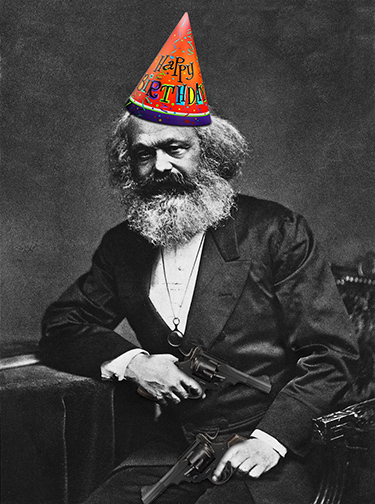
Father of Communism, Stepfather of Nationalist Socialism

Father of Communism, Stepfather of Nationalist Socialism
A few comments and reminders by Col Mike Walker, USMC retired


My thought on the birth of Karl Marx: May you rot in the Godless socialist hell you created.

Marx was no non-violent pacifist. Marx advocated violent revolution – civil war...

... and it did not end there; he demanded blood before during and after his revolution. 

Per the Communist Manifesto:

Chapter I: He saw the revolutionary path as a “more or less veiled civil war, raging within existing society, up to the point where that war breaks out into open revolution, and where the violent overthrow of the bourgeoisie lays the foundation for the sway of the proletariat.”

Marx utterly rejected pursuing change through a peaceful political process.

Chapter III: “Violently oppose all political action on the part of the working class.”

But it was his exhortation to create a violent socialist dictatorship in the wake of the revolution where the real seeds of genocide were sewn:

Chapter II: The revolution “cannot be effected except by means of despotic inroads…and are unavoidable.”

Chapter IV: “The Communists disdain to conceal their views and aims. They openly declare that their ends can be attained only by the forcible overthrow of all existing social conditions. Let the ruling classes tremble at a Communistic revolution.”

His words inspired, Lenin, Stalin, Mussolini, Mao, Hitler and a host of lesser socialist despots.

Yes indeed dear Karl, rot in one or all of the Godless socialist hells you created.

Sunday, May 06, 2018

Mueller’s Questions for Trump Show the Folly of Special-Counsel Appointments


Mueller’s Questions for Trump Show the Folly of Special-Counsel Appointments
Andrew McCarthy, National Review 

The Justice Department should not permit the president to be interrogated on so paltry and presumptuous a showing.

I am assuming the authenticity of the questions that Special Counsel Robert Mueller reportedly wants to ask President Trump. The questions indicate that, after a year of his own investigation and two years of FBI investigation, the prosecutor lacks evidence of a crime. Yet he seeks to probe the chief executive’s motives and thought processes regarding exercises of presidential power that were lawful, regardless of one’s view of their wisdom.

If Bob Mueller wants that kind of control over the executive branch, he should run for president. Otherwise, he is an inferior executive official who has been given a limited license — ultimately, by the chief executive — to investigate crime. If he doesn’t have an obvious crime, he has no business inventing one, much less probing his superior’s judgment. He should stand down.

The questions, reported by the New York Times, underscore that the special counsel is a pernicious institution. Trump should decline the interview. More to the point, the Justice Department should not permit Mueller to seek to interrogate the president on so paltry and presumptuous a showing.

When should a president be subject to criminal investigation?
It is a bedrock principle that no one is above the law. The Framers made clear that this includes the president. But, like everything else, bedrock principles do not exist in a vacuum. They vie with other principles.

Two competing considerations are especially significant here. First, our law-enforcement system is based on prosecutorial discretion. Under this principle, the desirability of prosecuting even a palpable violation of law must be balanced against other societal needs and desires. We trust prosecutors to perform this cost-benefit analysis with modesty about their mission and sensitivity to the disruption their investigations cause.

Second, the president is the most essential official in the world’s most consequential government. That government’s effectiveness is necessarily compromised if the president is under the cloud of an investigation. Not only are the president’s personal credibility and capability diminished; such an investigation discourages talented people from serving in an administration, further undermining good governance. The country is inexorably harmed because a suspect administration’s capacity to execute the laws and pursue the interests of the United States is undermined. Naturally, this is of little moment to rabid partisans who opposed the president’s election and object to his policy preferences. By and large, however, Americans are not rabid partisans; they want the elected president to be able to govern, regardless of which party is in charge.

Still, the president cannot be above the law. Executive powers are too awesome to abide presidential immunity from the laws and the limits on those powers. So how do we police the president while minimizing the damage that an investigation of the president can do to the country? We acknowledge that we are willing to endure this damage, but only if there is strong evidence that the president is guilty of a serious crime or abuse of power.

A president should not be subjected to prosecutorial scrutiny over poor judgment, venality, bad taste, or policy disputes. Absent concrete evidence that the president has committed a serious crime, the checks on the president should be Congress and the ballot box — and the civil courts, to the extent that individuals are harmed by abusive executive action. Otherwise, a special-counsel investigation — especially one staffed by the president’s political opponents — is apt to become a thinly veiled political scheme, enabling the losers to relitigate the election and obstruct the president from pursuing the agenda on which he ran.

That is what we are now witnessing.

Pretextual appointment of the special counsel
Robert Mueller was appointed special counsel for two reasons: (1) ostensibly to take over a counterintelligence probe; (2) in reality, as a cave-in to (mostly) Democratic caviling over Trump’s firing of FBI director James Comey — which was lawful but incompetently executed. Democrats contended that Comey’s dismissal, in conjunction with Comey’s leak of Trump’s alleged pressure to drop the FBI’s investigation of Michael Flynn, warranted a criminal-obstruction probe. That is, the pretext of obstruction was added to “Russia-gate,” the already-existing pretext for carping about the purported need for a special counsel.

Neither of these reasons was a valid basis for a special-counsel investigation.

As we have repeatedly noted, a counterintelligence investigation is not a criminal investigation. To the extent it has a “subject,” it is a foreign power that threatens the United States, not an American believed to have violated the law. A counterintelligence investigation aims to gather information about America’s adversaries, not build a courtroom prosecution. For these (and other reasons), such investigations are classified and the Justice Department does not assign prosecutors to them, as it does to criminal cases. Counterintelligence is not lawyer work; it is the work of trained intelligence officers and analysts. It is not enough to say that Justice Department regulations do not authorize the appointment of a special counsel for a counterintelligence probe. The point is that counterintelligence is not prosecution and is therefore not a mission for a prosecutor.

Foreign efforts to meddle in our elections are nothing new, but they are not to be taken lightly. Russia’s effort plainly warranted a counterintelligence investigation. But reliance on that necessity as a rationale to appoint a special counsel — a lawyer independent of the executive branch, who uses the president’s executive power to investigate the president — was a subterfuge. (Because of Deputy Attorney General Rod Rosenstein’s passivity, Mueller is de facto independent, even though he is technically Rosenstein’s subordinate.)

Prior to Comey’s firing, Democrat demands for a “Russia-gate” special counsel were rebuffed because they were nakedly political. Even if one accepts the dubious premise that Trump materially benefited from Kremlin interference in the election, there was no known credible evidence that he or his campaign committed a crime in that connection. If there had been such evidence, no one would ever have mentioned a counterintelligence investigation; they would have said a special counsel was being appointed to investigate, say, a hacking conspiracy — an actual violation of federal criminal law.

The Democrats did not want a special counsel in order to investigate a crime; they wanted a special counsel (a) to promote a political narrative that Hillary Clinton lost because of something other than her lack of appeal and (b) to frustrate Trump’s ability to govern — to mollify their “Resist!” base, to stop Trump from implementing policies they oppose, and to enhance their electoral hopes in the 2018 and 2020 cycles.

As for the second purported basis for Mueller’s appointment, the crime of obstruction, it cannot be established by lawful exercises of executive prerogatives. A president, of course, may not subvert an investigation by unlawful actions — e.g., by conspiring to suborn perjury or bribe witnesses (cf. Clinton, Nixon). Illegal acts could amount to actionable obstruction. But the president’s dismissal of subordinate executive officials (such as the FBI director), and his exercise of prosecutorial discretion (by merely weighing in on whether a person — here, Flynn — deserves to be investigated), are constitutional acts that are not judicially reviewable. Executive prerogatives that are not subject to judicial review may not be subjected to judicial review by indirection, under the guise of a prosecution.

This is not to say that lawful presidential actions are beyond reproach. Acts that do not transgress the criminal law may nevertheless be despicable. It is not a crime, for example, for a president to use the Oval Office for extramarital trysts with an intern, or to lie to the public about people being able to keep their health insurance. Nor am I contending that lawful presidential actions are unreviewable: The president can be impeached — just as the president has plenary power to fire an executive subordinate, Congress has plenary power to determine what constitutes high crimes and misdemeanors. If Congress believes that the president’s lawful exercise of an executive prerogative was corruptly motivated, Congress may remove the president. If, for example, there was a concrete basis to suspect the president of a crime, and the president pardoned his accomplices in return for their silence, the pardons would stand but Congress could impeach the president for abusing his power to conceal his misconduct.

But impeachment is not prosecution. If Congress believes that Trump has committed impeachable offenses, it is free to open an impeachment inquiry. Mueller is not Congress. He does not report to Congress. He is a subordinate officer of the executive branch whose job is to investigate and (if merited) prosecute crimes specified by his Justice Department superiors. A special counsel is not supposed to be Congress’s lawyer for the purpose of investigating non-crimes that might nevertheless constitute impeachable abuses of power.

The corrupt-motive theory is legally and factually specious
The list of questions elucidates that Mueller is pursuing the legally suspect theory that legitimate exercises of presidential prerogatives can become prosecutable obstruction crimes if undertaken with an arguably corrupt motive. This theory is specious on at least two grounds.

First, it would empower a subordinate executive official (an unelected bureaucrat who serves at the president’s pleasure) to second-guess the chief executive’s every action and judgment — not just to investigate a patent, serious crime but to question what the president was thinking even when his actions were within his constitutional authority. The president is answerable to peer branches and to voters, but not down his chain of command. If an order is lawful, it is not the captain’s place to question the general’s motives.

Second, the corrupt-motive theory is factually meritless as applied to Trump. Whatever pressure Trump may have brought to bear regarding Flynn’s investigation, it had zero impact. Comey has testified that the FBI disregarded Trump’s comments. The Flynn investigation proceeded without a hitch, and Mueller ultimately charged and convicted him. Trump could have ordered the investigation to be shut down, but he let it continue.

As for the Russia investigation, it has proceeded apace. Comey’s firing had no effect on the FBI’s capacity to investigate. Moreover, the evidence is that Trump was not trying to impede the Russia investigation. To the contrary, the president simply wanted the FBI director to state publicly what he was assuring Trump privately: that Trump was not suspected of wrongdoing. This was hardly an unreasonable desire given that (a) in the Clinton-emails investigation, Comey took it upon himself to publicize the FBI’s determination that Hillary Clinton should not face prosecution, and (b) after repeatedly telling Trump he was not a suspect, Comey gratuitously created the public impression that Trump was a suspect by making an extraordinary announcement (in House testimony on March 20, 2017) that both revealed the existence of the Russia investigation and suggested Trump-campaign “coordination” in Russian espionage.

Not so fast, argue Trump’s antagonists: To be obstruction, an action need not succeed in corruptly influencing an investigation; it need only endeavor to do so.

This returns us to where we began: A president should not be under investigation in the absence of an obvious crime serious enough to implicate impeachment. The stakes for the nation’s effective governance are too high. Here, we do not have real obstruction. We have, at most, a politicized, hyper-technical claim of obstruction that rests on a suspect legal theory and a dearth of evidence that anyone was impeded in the slightest. Those are frivolous grounds for an investigation that compromises the president’s capacity to govern. The criminal law inquires into intent when actions patently violate criminal statutes; its purpose is not to manufacture crime by speculating about the intent behind apparently lawful actions.

Justice Department indifference
I am not a Trump fanboy. The administration’s conflicting explanations for Comey’s firing, which Mueller wants to inquire about, were an embarrassment — and the president’s badmouthing of the former director for the consumption of Kremlin emissaries was a disgrace. Trump’s Twitter tirades demanding investigations inject politics into law enforcement and undermine the administration of justice. His conception of the loyalty he is entitled to demand from law-enforcement officials is skewed — his citation of Eric Holder as a model attorney general (the only AG ever held in contempt of Congress) is repugnant. His orchestration of Donald Trump Jr.’s misleading statements to the Times (and thus to the public) regarding the Trump Tower meeting with a Kremlin-tied lawyer was unseemly.

None of this, however, is a basis for criminal prosecution. Being inconsolably upset about the outcome of the 2016 election does not entitle Democrats to an Oval Office minder with subpoena power. The actions and intentions Mueller seeks to probe are bases for political opposition to Trump, not prosecution. If you think his derelictions outweigh the positive policy outcomes of his presidency, then work to defeat him in the coming election cycles. But that is not prosecutor work.

Trump would be foolish to answer questions from Mueller, who has made a habit of turning witness interviews into false-statements prosecutions. More important, absent concrete evidence of his complicity in a serious crime, a president should not be put in the position of being pressured to answer a prosecutor’s questions. When Trump complains that the Obama Justice Department would never have permitted President Obama to be treated this way, he is right.

Put the president aside for a second. A Justice Department prosecutor would not be permitted to subpoena, say, a journalist or a lawyer, unless doing so was vital to the investigation of a serious crime — to the acquisition of critical information that was unavailable from any alternative source. The firewall that would prevent a heedless prosecutor from running roughshod over free-press principles or the attorney–client privilege is Justice Department leadership. It is astonishing that current Justice Department leadership apparently believes that the president of the United States, despite his responsibilities for our governance and security, is entitled to less deference.

Unless Mueller can demonstrate that a serious crime has been committed, that Trump was complicit in it, and that Trump is in possession of evidence that is essential to the prosecution, Rosenstein should bar him from seeking an interview, let alone issuing a subpoena demanding grand-jury testimony. This is not merely about protecting Trump; it is about protecting the office of the presidency.

— Andrew C. McCarthy is a senior fellow at the National Review Institute and a contributing editor of National Review. @andrewcmccarthy

Wednesday, May 02, 2018

SPEAKING OF COLLUSION


SPEAKING OF COLLUSION
Scott Johnson, Powerline  

The synthetic Russian “collusion” scandal in which we have been enmeshed since the inauguration of President Trump is closely related to the real Russian collusion scandal involving the Clinton campaign. Underlying both is a media scandal of epic proportions. Exposing the interrelationship of these scandals — synthetic, real, and media (also real) — has been the more or less exclusive domain Lee Smith. I urge interested readers to take the time necessary to absorb his devastating new Tablet column “Are NBC and CNN paying off top spies who leaked info with on-air jobs?”

If you’ve been paying attention, you know that Glenn Simpson and Fusion GPS “fuse” all three scandals. Here Lee comments on the Times’s recent report that the infamous Natalia Veselnitskaya was, shall we say, a close friend of Vladimir Putin and professional associate of — wait, Glenn Simpson. But the Times forgot that last part. “Here’s the story in full,” with the omitted parts filled in by Lee Smith:

A British music publicist arranged Veselnitskaya’s June 9, 2016 meeting with Donald Trump Jr. at the Trump Tower by promising dirt on Clinton. “If it’s what you say, I love it,” the president’s eldest son replied by email.

But Veselnitskaya had nothing on Clinton. She wanted to discuss the U.S. law imposing sanctions on Russian government officials and other figures close to Russian president Vladimir Putin who are implicated in the detention and death of Sergei Magnitsky. He was a Russian tax accountant hired in 2007 by the Chicago-born financier William Browder to investigate the misappropriation of $230 million in taxes that Browder’s firm had paid to the Russian government. Magnitsky was arrested in 2008 and was found dead a year later in a Moscow jail cell. The Magnitsky Act is the sanctions legislation that Browder spearheaded to punish those involved, and fire a shot across Putin’s bow.

In turn, Veselnitskaya was hired to represent a firm owned by Kremlin associates charged by the Justice Department with laundering some of the profits from the tax fraud that Magnitsky was investigating on behalf of Browder when he was arrested. Since the fraud case and the Magnitsky Act touch on Russian national interests, as well as Putin’s personal interests, it’s only natural the lawyer handling the case would be in close touch with the Kremlin’s top lawyer.

Yet the Times piece from last week barely touched on Magnitsky. His case, the story explains, “became a cause célèbre in Washington,”—in fact it gave rise to American legislation. The Times article didn’t mention Browder at all. Why? Because that would’ve widened the lens of a story that is tasked to show the Trump team’s ties to Kremlin affiliates, and raised some uncomfortable questions that undermine the governing narrative, which is that Trump colluded with Russia in order to steal the Presidency from Hillary Clinton.
More detail in the Times story would show that one of Veselnitskaya’s partners in the anti-Magnitsky campaign was Fusion GPS. Glenn Simpson’s opposition research shop had been brought on to run a smear campaign against Browder in the press. The talking points on Magnitsky and Browder that Veselnitskaya recited in the Trump Tower meeting, talking points that she previously shared with Russia’s prosecutor general, were quite literally written by Fusion GPS.

Fusion GPS—that’s the same firm that was hired by the Clinton campaign and the DNC to produce the Steele dossier. So Fusion GPS disseminated reports of the Trump team’s ties to Russia in order to warn America of a possible criminal conspiracy that would sell out U.S. interests in exchange for help securing the presidency—while it also worked on a campaign defending Kremlin interests by undermining an American law. How, you ask, is that possible? And why didn’t the Times report that salient fact?

Because the Times was in bed with Fusion GPS too. William Browder told me that when he was trying to get various journalists to report on Fusion GPS’ role in the campaign against him and the Magnitsky Act, he found that the company’s founder Glenn Simpson “was so deeply embedded as a source for different stories, no one wanted to write a story about him.”

I urge interested readers to consume the whole devastating thing here.

Thursday, April 26, 2018

ON RACE AND INCOME INEQUALITY


No, this isn't a racist rant, but as Eric Holder says, "We need to have a basic race discussion." 
Okay Eric, here's some facts.

New Study Raises Questions, Sheds Light on Race and Income Inequality
PAUL MIRENGOFF, powerline

The Washington Post reports on a study comparing black and white incomes. The study found that virtually nowhere in the United States do black boys grow up to earn incomes equivalent to white boys raised in the same neighborhoods by parents with comparable wealth and education levels. The disparity holds true even for black boys raised in the wealthiest of families, who grew up on the same block in the same affluent community and attended the same school as their white counterparts.

What’s the explanation? My first thought was that it might lie in differences in family structure. Perhaps, across all income levels, young black men grow up in less stable families.

It’s true that, in general, young black men labor under this disadvantage. But as I read the study, family structure does not explain differences in black and white incomes among those raised in families with comparable income in comparable neighborhoods. The authors state:
Black children are much more likely to grow up in single parent households with less wealth and parents with lower levels of education — all factors that have received attention as potential explanations for black-white disparities. 
But when we compare the outcomes of black and white men who grow up in two-parent families with similar levels of income, wealth, and education, we continue to find that the black men still have substantially lower incomes in adulthood. Hence, differences in these family characteristics play a limited role in explaining the gap.
Is the gap, then, explained by racism? Perhaps, but two clues suggest otherwise.
First, the Black-White income gap observed by the study exists only for men. Controlling for the income of parents and the neighborhood in which children are raised eliminates any income disparity between white and black women. If anything, black women apparently make out slightly better than their white counterparts.

Does white racism extend only to black males. It’s possible, I suppose. But someone should explain why that’s the case. I always figured that if you’re anti-black, you’re anti-black regardless of gender. Certainly, women were not exempt from Jim Crow laws.

Second, the study found that, black males are more likely to be incarcerated and less likely to attend college than their white counterparts from families of similar income level. Herein lies the answer, I think. Black boys/men are faring worse with regard to income than similarly situated white boys/men because of the decisions they make — e.g., decisions about whether to engage in crime and whether to attend college.

Leftists contend that blacks are incarcerated at higher rates than whites because of racism in the criminal justice system. I don’t believe this. But let’s assume it’s true and focus on the fact, established by the survey, that black boys are less likely to attend college than white boys from the same background.

Is this because of racism? Surely not. Colleges aren’t discriminating against blacks in admissions. To the contrary, most colleges are discriminating in favor of blacks, via race-based preferences that enable blacks to obtain admission with significantly worse credentials — grades and especially test scores — than whites.

And keep in mind that black women are doing fine compared to their white counterparts — both as to income and college admission. Are we supposed to believe that college admissions officials are discriminating against black men but not black women? The notion is ridiculous.

Are black boys being knocked or routed off the college track earlier in the process, as compared to white boys from similar circumstances? This notion too seems implausible.

Who is doing the knocking and how are they accomplishing it? Are racist guidance counselors discouraging black boys, but not black girls, from taking college track courses and/or from applying for college? Are racist teachers giving bad grades to black boy, but not black girls, for no good reason? Are they suspending them without good cause?

Few will have consumed enough identity politics Kool-Aid to believe that this is what’s going on. The logical explanation for the disparities observed in the study is that, across all income lines, young black males, to a disproportionate extent, are behaving in ways that do not optimize their future earnings.
http://www.powerlineblog.com/archives/2018/04/new-study-raises-questions-sheds-light-on-race-and-income-inequality.php

Wednesday, April 25, 2018

THE GREAT EARTH DAY YAWN


THE GREAT EARTH DAY YAWN
Steven Hayward, Powerline

Wait—yesterday was Earth Day! I must have yawned right through it. Like most Americans, if you go by the surveys showing increasing public indifference toward environmentalism.

I used to make a big deal out of Earth Day, pointing out for years that the data in rich countries showed an almost unbroken record of significant environmental improvement is just about every major category. This would send environmentalists into howls of outrage, because good news is bad news for Crisis Entrepreneurs.TM A good example of the broken (plastic!) record of environmentalism comes to us this morning courtesy of the usually half-sober folks at Nature magazine:

Well duh. Every adverse condition hits poorer countries first, BECAUSE THEY’RE POOR! I guess the Nature editors have never heard the old joke about how the New York Times would cover the imminent end of the world: “World to End Tomorrow: Women, Minorities Hardest Hit.” Maybe they have heard it, and don’t get it, which is entirely typical of people deprived of a sense of humor because of their fanaticism.

Just a hunch here, but if you ask people in poor countries what they’d most like to see the world emphasize right now—rich countries cutting their carbon emissions, or helping poor countries get rich—I’m pretty sure I know which option they’d choose. Because, based on the revealed preferences of what kind of energy systems poor countries are building—hint: a lot of it rhymes with “goal”—tell us the answer pretty clearly. Or ask yourself this question: which country is more able to handle any natural disaster from whatever cause: Singapore, or next-door Malaysia? This is the reason India has consistently said they want to get rich first before signing on to any future energy constraints.

Beyond the fading issue of climate change, the entire story arc of environmental disaster from the first Earth Day in 1970 has just about run its course. Increasingly you see more and more evidence of the spreading recognition of the dominance of human progress in all areas, whether it is Steven Pinker’s new book, Enlightenment Now, or Charles Mann’s new book The Wizard and the Prophet (about how Norman Borlaug routed Paul Ehrlich in the real world), or the copious data work of Max Roser’s terrific data analysis project at Oxford University, Our World in Data, or a similar efforts housed at the Cato Institute, HumanProgress.org, just to name a few.

But perhaps my favorite effort at the moment is the posthumously published book just out from Hans Rosling, Factfulness: Ten Reasons We’re Wrong About the World—and Why Things Are Better Than You Think. Rosling, who passed away last year at the too early age of 68, was called “the Jedi master of data” for his inventive ways of explaining trends. He founded the indispensable website called Gapminder (check it out—it makes data analysis fun!) A main reason for doing the book is that Rosling notes that even world leaders labor under huge misconceptions about the true state of humanity. “And this leads to terrible decisions. . . How is it possible that so many people are getting so many things so wrong?”

This five-minute video shows his kids explaining the project, and includes a couple of short explanations from the late Hans Rosling:


And here’s one of his classics—200 Countries, 200 Years, 4 minutes:


https://youtu.be/8-kbZiCX7h4

https://youtu.be/jbkSRLYSojo

Tuesday, April 10, 2018

The Ideology of Illegal Immigration


The Ideology of Illegal Immigration
Victor Davis Hanson, National Review

Gang members next door and dead dogs dumped in your yard? Don’t complain, or you’ll be called racist.

llegal immigration has become so deeply embedded for so long within contemporary power politics, demography, and cultural change, so charged with accusations of racism, nativism, and xenophobia, that we have forgotten its intrinsic contradictions.

We saw a glimpse of reality with the recent “caravan” of Central Americans. With a strong wink and nod from their Mexican hosts, the travelers assumed an intrinsic right to march northward into the United States. Had they done so, they would have confirmed the impression, advanced during the last administration, that the border is porous and that a sovereign United States and its citizenry have scant legal right to secure it.

How did we get to such a point of absurdity?

The ideology of illegal immigration rests on certain illogical assumptions that must not be questioned. Immigration exactly is one-way. But why exactly do we simply accept that without inquiry? What is it about a free-market, constitutional, transparent, and law-abiding America that draws in millions desperate to abandon their homes in otherwise naturally rich landscapes in Mexico and Central America?

In the absence of intellectual honesty about the need for political and economic reform in Latin America, mythologies can abound. Millions are desperate to enter a country antithetical to the protocols of their own. They are even more desperate to stay here — even as many mask that paradox by expressing ethnic and cultural chauvinism, along with anger at their hosts. Witness the signs, flags, and symbols of many open-borders, anti-immigration-enforcement rallies. Apparently, nations that create conditions that drive out their own can be the objects of romance, but only at a safe distance.

The ethos of the Mexican government has become surreal. Its racist and imperial classes welcome the flight of 10 percent of its indigenous population. It assumes that the United States cannot, must not, adopt immigration laws similar to its own. Driving out one’s own people apparently vents social tensions in lieu of reform, and the government is thereby exempted from accountability for its utter failures. About $30 billion arrive in return as remittances, many of these transferences subsidized by American social services and entitlements.

To hide the asymmetry, Mexico becomes accusatory, playing the same role that China does with trade. The aggressive party is always the victimized. Mexico constantly warns us that an anti-American, left-wing presidential candidate, Andrés Manuel López Obrador, may soon be elected.

But what exactly would the feisty Obrador do in anger: Punish the U.S. by closing the southern border, unilaterally quit NAFTA, accommodate the repatriation of 12 million of its citizens, build a wall of his own, forbid the emigration of the impoverished of Oaxaca, expel U.S. companies and investments, cut off the reception of billions of dollars in American remittances, drive out U.S. citizens, or demand the extradition of its own citizens now in American jails and prisons? And what would be the U.S. reaction to such “punitive” measures?
Promises, promises?

The illegal-immigration project will ultimately fail because although its politics are transparent, its practice is incoherent, and chaos is therefore its only possible end. With the exception of an ailing European Union, no other country in the world — certainly not Mexico or China — would allow its open borders to become as politically weaponized as America’s. Yet no other nation is so faulted as illiberal as is the uniquely liberal United States. The result is a growing American exasperation. Ingratitude and hypocrisy stir human passions like few others traits.

The entire vocabulary of illegal immigration has become Orwellian. Once descriptive nouns and adjectives such as “alien” and “illegal” have melted into “undocumented” and “immigrant” and then into just “migrant,” ostensibly to mask the reality of both legal status and the fact that migrants go in one direction — and there is an existential difference between immigrants and emigrants.

Illegal immigration is defended as a gift to the United States, as if without millions of illegal arrivals, America would ossify. But aside from the fact that the labor participation rate of America is about 62 percent of the available work force, and millions have given up on seeking jobs, when the proponents of illegal immigration south of the border are asked politely to withdraw their supposed beneficence and generosity, they react with furor and slander rather than with gratitude and relief.

Once someone makes a decision to enter a country illegally — his first decision as an incoming alien — and thus breaks a U.S. law with impunity, then most subsequent decisions are naturally shaped by the idea of exemption. Zealots argue that entering the U.S. illegally is merely a civil infraction. But the IRS in 2017 identified some 1.2 million identity-theft cases, in which illegal aliens had employed illegitimate or inconsistent social-security numbers to file tax returns — and implicitly thereby cause innumerable problems for the U.S. tax system.

Any U.S. citizen who did that would be charged with a career-ending felony. And identity theft — the great unspoken twin of illegal immigration — is not just a minor infraction, as I can attest from having my name and checking-account number stolen by an illegal alien. False checks, identical in color and style to my own, were then printed up by him with his name and phony address on them, albeit using my banking router number at the bottom; he then cashed the checks at a compliant rural store, using a false identity, stamped on the back in the form of a fraudulent driver’s license and bank credit card. Multiply that reality thousands of times over per month — but never dare to suggest that such a crime is connected with illegal immigration or even constitutes much of a crime.

So much of the discussion of illegal immigration is predicated not just on fantasy, but on Soviet-style censorship, and not just of speech, but of our very thoughts. Taboo are suggestions that illegal immigration could be a prime reason that California now has the highest basket of income, sales, and gas taxes in the nation; the highest number of welfare recipients (one of three in the United States), with a fifth of the state living below the poverty level; and now a fourth of all hospital admittances found to be suffering from diabetes or prediabetes; or that national rankings of infrastructure quality place the state nearly last in the country.

Talk of race has approached something like Lewis Carol’s Through the Looking Glass, in which everything is upside down. “La Raza” — until recently the nomenclature of the nation’s largest Hispanic advocacy organization — has supposedly nothing to do with race, while others who would never have an odious desire to use its odious English equivalent, “The Race,” are deemed racists for their objections to La Raza terminology.

Residency is deliberately conflated with citizenship, as if the two are legally and morally equivalent. But again, nowhere else in the world is this true, and certainly not in Mexico. I have lived abroad for over two years. As a guest in Athens, I followed Greek politics closely. I paid steep Greek sales taxes and assorted fees and tariffs as a legal resident alien. But at no time did I imagine that taxes or my physical presence as a lawful guest on Greek soil allowed me to interfere with the politics of my host, much less to issue demands on Athens, or to give me de facto the same legal rights as Greek citizens. As a legal alien, I surely did not think I could vote. I knew better than to tell Greeks that their country was not to my taste. And I knew fellow aliens who overstayed visas, worked without permits, and did not register as foreign residents. At least before the days of the latest incarnations of the European Union, the resulting fines were stiff, and expulsions were uncontested.

Illegal immigration is embedded not within racial and political ecumenicalism but within an exclusionary ethnic and political matrix. There would be no lectures about principle and logic from a Jorge Ramos or Vicente Fox were a million a year from China or Africa entering the southwestern United States illegally — except as likely voices of opposition to such unlawful and asymmetrical influxes in their own countries’ neighborhoods. In our upside-down world, calls for diverse, legal, meritocratic, and measured immigration are considered xenophobic, precisely because they would be racially blind and not predicated on current racial and ethnic chauvinism.

Without illegal immigration at current levels, the powers of assimilation, integration, and intermarriage would turn most immigrants into Americans within two to three generations, as in the past. That fact apparently frightens ethnic chauvinists, who disguise the advantages they gain from identity politics by smearing those who wish to at least make race and ethnicity incidental and not essential to our characters. If Univision eventually went the way of 19th-century German-language daily periodicals, what would a Jorge Ramos do?

For those who live at the nexus of illegal immigration, life is lived quite differently than in the past, from the trivial to the existential. A few examples suffice. Last night I was awakened by automatic gunfire on the road at 2 a.m.; the shots came from a long-ago-sold farmhouse of one who was a friend and neighbor for 50 years, but whose house is now rented out to gang members, many from Mexico. No worry, within an hour, the shrieks of resumed cockfighting returned as usual.

Do PETA members object to illegal immigration? We play a sort of rescue-dog roulette. Dogs are tossed and dumped on the side of road, without licenses, vaccinations, unneutered and unspayed, and often injured. After we reach our limit of adoptions — six presently — we try to vaccinate, neuter, license, and heal additional strays that wander in off the road, put shiny collars with tags on their necks, and let them feed and roam near our fenced yard. Then a welcomed reverse but invisible process can sometimes follow: theft. Dogs formerly dumped are now recycled, as it were, snatched stealthily by new owners who steal back mysteriously “improved” pets rather than throw out a dog.

In rural California, the law as it once was is now often inoperative, if not sometimes nonexistent. Utility and common practice substitute. In my neighborhood, I assume that zoning and building-codes statutes apply only to those who are citizens and have the means to pay for permits and possible fines. Everyone else does what he pleases, assuming either that it would be illiberal to fine the Other or not cost-effective in a bankrupt state.

Illegal immigration and environmentalism war with each other. But the former usually is exempted from any green audit. No one much cares, certainly not law enforcement or the state and federal environmental agencies, that roadsides outside Central Valley towns are littered with abandoned appliances, furniture, tires — and toxic and wet garbage. I suppose if it became a county issue, the complainers would first be called whiners and then nativists. So silence reigns. In a pre-civilization manner, the law-abiding of all races and classes quietly pick up the garbage in their environs each week.

Behind the official silence is apparently the apologia that poverty prevents proper disposal, or that illegal arrivals still naturally follow protocols found south of the border, or that the citizen hosts are a bit too anal retentive and judgmental in harping about mere moldy mattresses or old televisions set in their alleyways or orchards.

Again, the logic of illegal immigration is that the guilty host must accommodate the uninvited but more virtuous guest, not vice versa. When I find a dumped rotten canine carcass with a rope still around its skeletonized neck or a tossed disemboweled chicken, I surely must not privilege my own culture and think that dog- or cockfighting is barbaric. Perhaps the pile of used hypodermic needles dumped by my barn were left by accident? Today I pick up sacks of wet garbage with the owner’s name and address on several bills: Does one redeliver back to the dumper, and if so, armed or not? Or does one find it not cost-effective to do so? (Do not suggest “call the authorities” — that is a complete waste of time.) These are the small, mostly trite decisions that a person at the nexus of illegal immigration makes every day.

When a foreign gang member drives in, without English fluency, looking for the house of a drug seller, or asking about a neighbor’s trailer of prostitution, I don’t impose my values on him, but offer a polite, “No lo se.”  Live and let live as it were — given the alternative of possibly facing criminal exposure by calling authorities and thereby by aiding and abetting ICE.

Most assume that if hit by an illegal-alien driver (with a license or not), the latter, if unhurt, flees the scene of the accident. Only a naïf would think that registration or insurance would ever be found on the abandoned vehicle. When someone scrapes my car in the parking lot, the driver, if caught, sometimes wants a quick cash transaction to avoid calling the police.

When Jerry Brown or Nancy Pelosi lectures the state on its illiberality, or on the immigration sins of Donald Trump, or the advantages of nullification and a sanctuary state, we assume that these are just the penultimate chest poundings and virtue signals of rich septuagenarians about to go into apartheid retirements in Napa or Grass Valley.

In that context, all of their legacies above make perfect sense.

VICTOR DAVIS HANSON — NRO contributor Victor Davis Hanson is a senior fellow at the Hoover Institution and the author, most recently, of The Second World Wars: How the First Global Conflict Was Fought and Won. @vdhanson

Wednesday, April 04, 2018

ON THE EPA: STAY ON TARGET!


ON THE EPA: STAY ON TARGET!
Steven Hayward, Powerline

There’s an old saying that when you’re taking a lot of flack, you know you’re over the target. Right now this explains the liberal/media freakout about EPA administrator Scott Pruitt. Pruitt is systematically dismantling the legacy of decades of egregious bureaucratic overreach by the EPA, including ending the corrupt “sue-and-settle” practice, stopping the practice of refusing to share raw data with outside researchers that bear on multi-hundred-billion dollar regulatory schemes, and deep-sixing the so-called “Clean Power Plan,” which was likely to fail in federal court anyway. (This week’s sensible decision to rescind the Obama new car fuel economy requirements is being completely misreported, of course, but that subject will require a separate post.)

The height of irony is Obama’s EPA head Gina McCarthy complaining that Pruitt is using the very same powers that she used—the administrator’s prerogative to decide policy. Here’s McCarthy’s complaint to the NY Times:

Scott Pruitt, the administrator of the Environmental Protection Agency, has announced that he alone will decide what is and isn’t acceptable science for the agency to use when developing policies that affect your health and the environment.

And just who was it who set up the EPA administrator with such plenipotentiary powers? That’s right: liberals did (to be sure, with the foolish acquiescence of Republicans a long time ago), because they understood that the bureaucracy could be transformed into a partisan tool to achieve their ends, all the better if single administrators were given lots of power and didn’t have much political accountability even inside their own agency. When I suggested in the Wall Street Journal back in 2013 that the EPA ought to be made into a five-member commission like similar regulatory agencies that observe the need to reflect the partisan divisions in the country over policy, environmentalists howled in protest that my idea would “cripple the agency!” Well, just now I expect they’d rather prefer my idea to Administrator Pruitt.

Pruitt’s changes are long overdue, and as in so many other ideas, no previous Republican administration has seen fit to attempt any of these essential reforms. The last President Bush gave us Christine Todd Whitman as head of the EPA, who was a fluffy lapdog for the EPA bureaucracy. Anyone think President Jeb Bush would have given us Scott Pruitt?  (And let’s recall who promoted Gina McCarthy in Massachusetts’s state environmental bureaucracy before she went to work for Obama: a governor named Romney.)

The Pruitt news-storm is obviously not a coincidence or a spontaneous interest: the Environmental-Industrial Complex is geared up into full battle mode, and is undoubtedly funneling pre-packaged attack stories to sympathetic producers, reporters, and editorial writers. This is a cage match that isn’t going to go away. A lot of congressional Republicans may get cold feet, and if Democrats take the House in November, Pruitt can expect to be appearing before House committees every day. The media may well contrive a scandal.