Saturday, May 21, 2022

Clinton Lawyer’s Achievement: Getting Donald Trump Elected President


Clinton Lawyer’s Achievement: Getting Donald Trump Elected President

Apparently, Michael Sussmann hoped the FBI and New York Times would whip each other into a Trump–Russia collusion frenzy. Instead, they compared notes and torpedoed Clinton’s ‘October surprise.’

Andrew C. McCarthy, National Review

I don't know if Michael Sussmann will be found guilty of making a false statement to the FBI. Special Counsel John Durham’s team has so far put in what appears to be a convincing case, and Sussmann’s defense seems incoherent. The D.C. jury was always going to be tough for Durham, however, and it’s been made tougher still by the judge’s refusal to exclude for cause jurors who were admirably candid about having contributed to Democrats, strongly supported Hillary Clinton, and opposed Donald Trump.

Whether or not Sussmann beats the rap, though, there is some poetic justice here. He and his too-clever-by-half gaggle of Hillary Clinton campaign schemers probably did manage to get Donald Trump elected president. That may be harder for Sussmann to live with than a felony conviction.

As our Isaac Schorr has related (here and here), Durham’s key witness is James Baker. Now a top lawyer for Twitter, Baker in 2016 was the FBI’s general counsel. He has a wealth of national-security-law experience, having served for years as a Justice Department lawyer working foreign counterintelligence matters. And it was that experience that brought him into contact with Michael Sussmann, who similarly worked at DOJ in cybersecurity. Over the years, the colleagues became friends and remained in frequent contact.

Baker is a smart lawyer, introspective and willing to own up to errors, but smoothly articulate. He needed all of that this week, in hours of testimony stretching across parts of three days, that became heated at times. I am not in the courtroom, which is always a disadvantage. But in the reporting, it is not hard to detect some righteous anger below Baker’s serene surface. At the end of Thursday’s combative session, when Sussmann lawyer Sean Berkowitz smarmily reminded Baker that he was under oath and should be mindful of the potential criminal consequences of perjury, it must have required all Baker’s reserves to maintain his even keel.

But he did. It had to help that Baker’s story lines up with the independent evidence. That includes, more prominently, Sussmann’s own unfiltered words, in a text to Baker. There, he insisted that, in bringing the FBI “sensitive” information (about a supposed Trump–Russia communications back channel, it turned out), “I’m coming on my own — not on behalf of a client or company — want to help the Bureau.” That is exactly the misrepresentation Durham has charged against Sussmann, who was actually representing the Clinton campaign.

By contrast, how rich of Sussmann’s counsel to posture as if Baker is the one suffering from a loose association with the truth. Their defense is that Sussmann was representing the Clinton campaign, but then somehow wasn’t when he went to see Baker . . . even though he billed the Clinton campaign for the meeting . . . a meeting for which he prepared with Clinton campaign operatives . . . who were manufacturing this tale about a Trump–Russia communications back channel . . . which just happens to be the very tale that Sussmann peddled to Baker.

Well good luck with that. It’s not the sort of story that would get very far with most people, but hey, they may love it in Washington.

Meantime, Baker’s testimony shed light on a bit of intrigue that backfired royally on the Clinton campaign and may just have helped Trump squeak past Hillary in the 2016 election.

One of the great ironies of that campaign is that, for all Trump’s complaining about the “failing” New York Times and the FBI under former director Jim Comey (of whom Baker is a longtime friend and was a top adviser), the irrefutable fact is that the Gray Lady and the bureau combined to eviscerate the Clinton campaign’s Trump–Russia collusion narrative on the eve of the election, just as that narrative might have gained traction. As Durham has demonstrated, Hillary can probably thank her lawyers for that — and herself.

Durham’s prosecutors convincingly argue that the Clinton camp was plotting an “October surprise”: explosive press revelations that the FBI suspected Trump was a clandestine agent of Russia. In autumn 2016, Sussmann pushed the “Trump–Putin secret Alfa Bank back channel” on Eric Lichtblau, then of the New York Times. Lichtblau was skeptical. To raise the ante in a way that might make the story more attractive to the Times, Sussmann sought to entice the FBI into investigating the matter, trading on his personal relationship with Baker and his credentials as a former government official who cared deeply about American national security.

Sussmann’s defense now claims he went to the FBI, not on behalf of the Clinton campaign, but as a good citizen — you know, the kind of good citizen who billed the Clinton campaign for his time meeting Baker. Sussmann did this, his lawyers now maintain, even though it was against the campaign’s interest. How so? Because Sussmann must have known the FBI would contact the Times and get Lichtblau to hold off on running the story, when what the campaign most wanted was for the story to be published.

It’s a preposterous defense (although, again, who knows, maybe it’ll fly in Gomorrah on the Potomac). All we’ve heard from the defense about Sussmann so far is what a high-minded, ethical lawyer he is. Well, as a well-compensated Clinton campaign lawyer, Sussmann had a professional duty of fealty to his client; therefore, he would never have taken a position, based on personal considerations, that would harm the campaign’s interests. Moreover, as he prepared for his meeting with the FBI, Sussmann was collaborating closely with his partner Marc Elias (the top Clinton campaign lawyer) and Fusion GPS (the information firm Elias retained to dig up Russia dirt on Trump, which helped curate the data package Sussmann gave Baker). But most obviously, Sussmann and his lawyers are employing the common ploy of concocting a defense in hindsight, based on the things they now know happened, as opposed to what Sussmann and his confederates were thinking at the time. They now know that the FBI did approach the Times, so they’re spinning a yarn about how the campaign would never have wanted that. In point of fact, at the time, it was exactly what the campaign wanted.

Sussmann knew Lichtblau had doubts about the Alfa Bank data — doubts we can assume were well-founded given this week’s FBI testimony about how nonsensical the package Sussmann presented to Baker was. (See Isaac Schorr’s report, here.) The campaign was betting that the Times would become more interested in the story if the paper knew the FBI was alarmed about a possible Trump–Putin back channel. As Baker explained in his testimony,

Sometimes reporters would want to report about the fact that the FBI was investigating something even if they did not have confidence in the underlying information. . . . They’re not reporting necessarily about the thing. They’re reporting about the FBI investigating the thing.

The Clinton campaign hedged its bets, though. While Sussmann worked on Lichtblau and the bureau, Fusion GPS — in consultation with Sussmann and Elias, and with the approval of Hillary Clinton herself — peddled the Alfa Bank tale to other reporters. They hit paydirt with progressive journalist Franklin Foer. (See Isaac’s Schorr’s report on the testimony of Fusion’s Lauren Seago.) On October 31, Foer’s blockbuster, “Was a Trump Server Communicating With Russia?”, was published by Slate. The October surprise was emerging. As the Clinton campaign had hoped, just eight days before the election, there was now a big national story alleging that Internet researchers had found a communications pipeline between the GOP candidate and the Kremlin.

Of course, Slate is not the New York Times. A Franklin Foer piece, while influential in some circles, could not have the same impact as a Times report that said the FBI was investigating Trump. That’s what Clinton campaign officials were still banking on, and with Sussmann having set the wheels in motion at the Times and the FBI, they still anticipated it would happen. Meantime, as soon as the Foer report was hot off the presses, Hillary Clinton and her adviser, Jake Sullivan, pounced, hyping the Alfa Bank story and boldly predicting that we’d soon learn that law enforcement was hounding Trump.

You may recall the tweets from Clinton and Sullivan from my late April column (excerpting reporting from the Washington Examiner’s Jerry Dunleavy):

On Halloween 2016, Clinton tweeted, “Donald Trump has a secret server. . . . It was set up to communicate privately with a Putin-tied Russian bank.”

Clinton later tweeted, “Computer scientists have apparently uncovered a covert server linking the Trump Organization to a Russian-based bank.”

She also shared a lengthy statement by then-Clinton campaign adviser, and President Joe Biden’s current national security adviser, Jake Sullivan. “This could be the most direct link yet between Donald Trump and Moscow,” Sullivan claimed. “This secret hotline may be the key to unlocking the mystery of Trump’s ties to Russia.”

Sullivan added, “We can only assume that federal authorities will now explore this direct connection between Trump and Russia.”

It was all going so well for Team Hillary . . . until the Times and the Comey FBI ruined everything.

As Baker testified this week, Sussmann told him the Times might be poised to run a story (though this was not actually the case because of Lichtblau’s skepticism). So Baker and the FBI did exactly what Sussmann and the Clinton campaign must have calculated that they’d do: They reached out to the Times. Baker, accompanied by the FBI’s then-top counterintelligence agent and its then-media relations official, held a meeting with Lichtblau and Steven Lee Myers of the Times. The bureau’s objective was to get the Times to delay publishing a story, which would allow some time for investigation, since if there was a communications back channel, there wouldn’t be the moment the Times exposed it.

Baker said Lichtblau tried to probe “how seriously we were taking this allegation and the extent to which we thought there was some type of nefarious activity between the Trump Organization and Russia.” That was to be expected, but the FBI officials may have been surprised by the reporter’s transparency. Lichtblau, Baker recalled, explained that Times reporters “weren’t quite persuaded yet about . . . whether this material showed the existence of a surreptitious communications channel.”

In essence, Sussmann and the Clinton campaign miscalculated. They assumed the FBI’s interest would be enough to induce the Times to run a story that Trump was in cahoots with the Kremlin even if reporters had serious doubts about the underlying data. Sussmann also appears to have overlooked an unavoidable aspect of relations between government investigators and the press. The Justice Department and the FBI do not like to ask the media for favors, such as delaying publication of a story, because you often have to give something to get something. Generally, the something that investigators end up giving journalists is an unusually expansive degree of insight into the matter under investigation.

And that’s what happened. To get an accommodation from the Times, the FBI agreed to a follow-up meeting, which Baker said happened a week or two later. The bureau officials acknowledged to Lichtblau that the FBI “had concluded that the materials we had obtained by Sussmann,” plus whatever the FBI did to “augment” and investigate, “did not substantiate that there was a surreptitious communications channel.”

The rest is history. On the same day that Foer’s Slate story appeared, and that Hillary Clinton and Jake Sullivan mobilized on Twitter, the Times published a report by Lichtblau and Myers — “Investigating Donald Trump, F.B.I. Sees No Clear Link to Russia” — which completely destroyed the Clinton campaign’s collusion narrative, and in particular the Alfa Bank smear.

The story, over which the Times kicked itself after Trump’s stunning upset win over Clinton, explained:

For much of the summer, the F.B.I. pursued a widening investigation into a Russian role in the American presidential campaign. Agents scrutinized advisers close to Donald J. Trump, looked for financial connections with Russian financial figures, searched for those involved in hacking the computers of Democrats, and even chased a lead — which they ultimately came to doubt — about a possible secret channel of email communication from the Trump Organization to a Russian bank.

Law enforcement officials say that none of the investigations so far have found any conclusive or direct link between Mr. Trump and the Russian government. And even the hacking into Democratic emails, F.B.I. and intelligence officials now believe, was aimed at disrupting the presidential election rather than electing Mr. Trump.

Specifically on the back-channel canard, the Times related that agents had 

focused particular attention on what cyberexperts said appeared to be a mysterious computer back channel between the Trump Organization and the Alfa Bank, which is one of Russia’s biggest banks and whose owners have longstanding ties to Mr. Putin.

F.B.I. officials spent weeks examining computer data showing an odd stream of activity to a Trump Organization server and Alfa Bank. Computer logs obtained by The New York Times show that two servers at Alfa Bank sent more than 2,700 “look-up” messages — a first step for one system’s computers to talk to another — to a Trump-connected server beginning in the spring. But the F.B.I. ultimately concluded that there could be an innocuous explanation, like a marketing email or spam, for the computer contacts.

In the end, Sussmann got his New York Times story about an FBI investigation of Trump. But the October surprise was on Hillary. The lawyer seems to have thought he was a puppet master, pulling the strings of the nation’s most prominent newspaper and law-enforcement agency. But when they compared notes, it was the Clinton campaign that ended up tied in knots. Indeed, the story not only eviscerated the Trump–Russia collusion claims (at least as an election issue); it reminded readers that the FBI had reopened the Hillary Clinton emails investigation. That investigation would be re-closed a few days later, but the damage was done.

Watching Michael Sussmann’s trial defense, one senses the weaving of another tangled web. Maybe he won’t get caught in this one. But he’ll always be tethered to the last one.


ANDREW C. MCCARTHY is a senior fellow at National Review Institute, an NR contributing editor, and author of BALL OF COLLUSION: THE PLOT TO RIG AN ELECTION AND DESTROY A PRESIDENCY. @andrewcmccarthy

Tuesday, May 17, 2022

Everyman’s Bill Buckley


Everyman’s Bill Buckley

M. Stanton Evans was ahead of his time, foreseeing many of the problems we face today.

by Daniel Oliver, Claremont Review 

According to Steven Hayward, M. Stanton Evans was the perfect conservative. He was a journalist of the first rank; a political activist; a thinker and theorist (one of the rare writers who is “both literate and numerate, conversant with physics as well as with metaphysics”); and ahead of his time in perceiving the issues we’re struggling with today. He foresaw the extra-constitutional nature of the administrative state, the class interests of the elites and their hostility to traditional culture, and the oppressive conformity of university campuses. His first book, Revolt on the Campus (1961), for example, describes two phenomena that we today call “political correctness” and “cancel culture.” It’s easy now to say “of course.” But Evans was onto these issues decades ago.

A Claremont Institute senior fellow and U.C. Berkeley senior resident scholar, Hayward has produced a splendid biography of Evans that doubles as a history of the conservative movement from its earliest days. It’s probably unsettled whether the movement’s Big Bang occurred in 1955 when William F. Buckley, Jr., founded National Review magazine, or in 1951 when he published God and Man at Yale. Regardless, the Left had fair warning. And Evans was there almost from the beginning, graduating from Yale in 1955.

* * *

Like Buckley, Evans had a father to help form his early opinions. Medford Evans wrote an article in 1957 explaining “Why I Am an Anti-Intellectual,” in which he called modern intellectuals “treacherous and stupid.” Plus ça change! Evans almost certainly heard that from his father for years. And when he got to Yale, Evans concluded as Buckley had that the people in Yale’s religion department didn’t appear to believe in God. Today, Harvard University’s chaplain is an atheist. Neither Evans nor Buckley would have been surprised.

Buckley was, if not suave, at least polished and proper; Evans was much simpler, much more like America, and much more like most conservatives than the posh members of Republican country clubs. As one friend described it, Evans would sit in his apartment “in a pair of old khakis and an undershirt, chomping on a loaf of Wonder Bread, washed down by a bottle of Big Grape while watching Roller Derby on TV.” In my obituary of Evans, which Hayward quotes, I called him “everyman’s Bill Buckley.” Just so.

In 1960, the polished and proper Bill Buckley and the everyman’s Bill Buckley gathered at the Buckley family estate in Sharon, Connecticut, with about 90 other young conservatives to form Young Americans for Freedom (YAF). One of the most important pieces Evans ever wrote was the now-legendary Sharon Statement, the founding principles of YAF. It could have been written last week. It begins, “In this time of moral and political crisis….”

* * *

Evans was right on too many issues to be mentioned in a review, and some took place long ago. One example: John F. Kennedy’s “missile gap.” Running against Dwight Eisenhower’s successor-not-to-be Vice President Richard Nixon, Kennedy accused Eisenhower of having allowed a “missile gap” to develop between the U.S. and the  USSR. It was all fiction, typical of the Kennedys. But Evans was skeptical of the Kennedy claim—and of Kennedy—right from the beginning. In a review of Victor Lasky’s book, JFK: The Man and the Myth (1963), Evans wrote,

When we peel away the surface trapping of family glamor and exalted utterance to discover what core of philosophy lies beneath, we find only a great emptiness. The tinseled wrapping is pure Madison Avenue, but what it conceals is just as implausible—a yawning void of ambition, unadorned by visible convictions on any major political issue.

Evans knew Camelot was a fantasy.

President Lyndon Johnson’s Great Society programs were another target of Evans, noting early on that they were turning into a sinecure for “caring” professionals of the welfare state. JFK’s brother-in-law Sargent Shriver, head of Johnson’s Office of Economic Opportunity, complained about an Evans column but proved his point: “I am confident that the new importance the War on Poverty is giving to the helping professions will have a beneficial effect both locally and nationally on the often inadequate salaries in those fields.” Evans understood the war between the Right and Left is really “a war between the permanent government and the elected government.”

Then came Ronald Reagan. It’s a long story of course, beginning many years before Reagan was first elected governor of California in 1966 and before the 1976 Republican National Convention that nominated Gerald Ford. But Evans was clear-eyed on the limits of personality. He wrote in The Future of Conservatism (1968), “It is tempting to suggest that, if Ronald Reagan did not exist, conservative Republicans would have to invent him. Tempting, but mistaken.” The point: ideas were more important than personalities.

Watergate was a disaster. Evans famously said he was for Nixon after Watergate. But he also wrote about the media’s double standard: how the Kennedy and Johnson administrations had bugged Republican campaigns using government agencies. “It is noteworthy,” he added, “that the people who most loudly condemn this clandestine effort to gather data on the Democrats are the self-same people who think it was fine for Daniel Ellsberg to abscond with data from the Pentagon and for the New York Times to publish it.”

* * *

By 1974 Reagan was an ever-growing presence in the Republican Party and the conservative movement. His speech at the 1974 Conservative Political Action Conference was well received, but was written up in National Review by a reporter who described the speech as “a rousing, lively speech, but not deep…. The crowd loved it. But there were skeptics, especially by the next morning, perhaps when they tried to remember what it was he had really said.” Evans wrote to Reagan telling him to ignore the criticism. That apparently made Reagan happy, but not his wife. Nancy Reagan called Bill Rusher, the publisher of National Review, to complain. But the reporter was not criticized by anyone at National Review, and in the following years Reagan gave more ideological and specific speeches.

But the 1974 speech didn’t really matter. Reagan was on the move. It would be inaccurate to say nothing could have stopped him, because in fact something almost did in 1976. Chasing the Republican nomination for president, he proposed a cut in the budget of about 25% and a cut in taxes of about the same amount. Collective Washington almost had a heart attack. Then, despite early polls showing Reagan surging ahead of President Ford, he lost the New Hampshire primary and the next five primaries as well. It looked like the end of the road.

But Evans didn’t give up. He flew to North Carolina to inject some badly needed enthusiasm—and cash (from the American Conservative Union)—into the campaign. Reagan won an upset victory. Veteran journalist Lou Cannon wrote that North Carolina was the turning point in Reagan’s political career. Jameson Campaigne, Jr., gave Evans the credit: “Without Stan Evans, it is quite likely there would have been no Reagan in 1980.”

The Reagan Administration was not without problems and disappointments for conservatives, and Evans was perfectly willing to criticize. He supposed, correctly, that there were hostile (i.e., non-conservative) forces afoot in the White House. Hayward tells the stories.

Hayward also writes about Evans’s journalism and his founding of the National Journalism Center (NJC), a school for young, aspiring conservative journalists. Evans was a brilliant journalist and he encouraged students to avoid “horse race journalism,” the kind that focuses on whether a bill will get enacted or a candidate will win rather than on what the bill or the candidate would do. And he would tell his students, “If your mother says she loves you, check it out.” The NJC was a terrific success. Many well-known journalists, such as John Fund, Ann Coulter, Mark Tapscott, Bill McGurn, and Malcolm Gladwell, are graduates. But money was always tight. A friend suggested to Evans that he ask each graduate to contribute $100 to the school each year—where the instruction had been free—after he had secured a paying job. Evans never did. By 2002 more than 1,600 students had been lucky enough to attend the NJC. The school could have been self-supporting.

* * *

Evans wrote ten books, but his most serious and philosophical was The Theme is Freedom (1994) which, as Evans says in the acknowledgments, “was a long time coming.” That kind of writing is…hard. Hayward says, “William F. Buckley Jr. gave up on writing a large synoptic statement of conservative political philosophy, finding the effort so discouraging that he took up writing novels instead.” You can see why.

As a final treat for readers, Hayward compiles Evans’s greatest quips, which include “Gridlock is the next best thing to having a constitution” and “The problem with pragmatism is that it doesn’t work.” That alone is worth the price of admission. But there’s one more Stan Evans witticism that is not on Hayward’s list.

Shortly before he died, Evans called me and asked if I would take over as chairman of the Education and Research Institute, which he had started decades earlier. You do not say no to an old friend near death from pancreatic cancer. So I said yes. He thanked me and then deadpanned, conspiratorially: “Dan, I’m not dying, but I don’t want anyone to know it.” A month or so later, he was dead. Perhaps he wanted it to be his last public witticism. Now it is.

You can read biographies of any number of prominent people who couldn’t hold a candle to the effect Stan Evans had on the politics of this country and, therefore, on the world. He was a remarkable man, as those of us who knew him for decades realized and as Steven Hayward has shown conclusively in this biography. The book is terrific—partly, of course, because Stan Evans is a terrific subject; but also because Hayward has done a magnificent job organizing the material and telling the story. Will some of the people mentioned, and their relatives and survivors, be unhappy with the result? I certainly hope so.


Daniel Oliver served as chairman of the Federal Trade Commission under President Ronald Reagan. He is currently a senior director of the White House Writers Group and a director of the Pacific Research Institute for Public Policy in San Francisco.

Monday, May 09, 2022

The Exasperated American


The Exasperated American

Will the voters channel their furor at this regime of lies into an unprecedented turnout at the polls in November? 

Victor Davis Hanson, American Greatness  

A large majority of Americans now have no confidence in Joe Biden and his administration, which often polls below 40 percent, with negatives nearing 60 percent.

Despite the 15-month catastrophe of his regime, the level of his own unpopularity remains understandable but still remarkable. After all, in 2020 voters already knew well of his cognitive deficits and the radicalism of his agenda. They saw both clearly starting in 2019 and during the 2020 Democratic primaries, the primary debates, and the general election.

So what did Biden’s voters imagine would happen when a cognitively challenged president, controlled by hard-Left subordinates, entered office—other than what he has done?

Now, as then, the media is fused to the progressive agenda and does—and did—its best to turn a non-compos mentis Biden into a bite-your-lip centrist empath in the Bill Clinton “I feel your pain” mode.

The American people know that on every occasion their president speaks, he will slur his words at best. At worst, he will have little idea where he is, where he has been, or what he is supposed to be saying or doing. When he is momentarily cognizant, he is at his meanest, or he simply makes things up.

Our new normal of a mentally incapacitated president is not entirely new in American history—Woodrow Wilson was an invalid during the last months of his presidency. But Wilson’s condition was well hidden. Quite novel is the idea that the American people know the man in the White House is cognitively disabled and simply expect him to confirm that bleak diagnosis each time he opens his mouth.

If Donald Trump exaggerated, Biden flat out lies daily. His most recent untruth was his assertion that the MAGA movement represents “the most extreme political organization that’s existed in American history.” Biden cannot really believe that roughly half the country is now more dangerous than Antifa, Black Lives Matter, the Weathermen, the American Nazi Party, the American Communist Party, and the Ku Klux Klan. And this comes from the mythically moderate “good old Joe from Scranton”?

The bullied people also know the Biden problem has no remedy. The 25th Amendment that Democrats and the Left raised nonstop in efforts to remove Trump—from the Rosenstein-McCabe wear-a-wire embarrassment and former Yale psychiatrist Bandy X. Lee’s congressional tomfoolery to the incessant Montreal Cognitive Assessment demands—won’t apply to Biden.

Either the media will continue to rebrand his incapacity as Ciceronian eloquence or it will privately gloat that Kamala Harris is so off-putting, so uninformed, so unpopular that the people would prefer an amnesiac Biden to a nonimpaired Harris. The truth is, the three doyens of Democratic progressivism—Joe Biden, Senator Dianne Feinstein (D-Calif.), and House Speaker Nancy Pelosi (D-Calif.)—all struggle with cognitive decline and rely heavily upon the media and the Democratic Party’s political attack machine to enjoy asymmetrical exemption. (Though, in Feinstein’s case, her support is wavering.)

Americans feel there is no remedy for this downward spiral until November. To get a sense of their dilemma, imagine a Richard Nixon in 1973 caught lying during Watergate but with Spiro Agnew waiting in the wings without a trace of scandal—except with one difference: the current media is now attacking not the president’s shortcomings, but the president’s critics who point them out.

Even if the Republicans were to win a 60-vote majority in the Senate, they would hesitate to impeach Biden simply because Harris is a more frightening prospect. And some Marquess of Queensberry centrist RINOs would not wish to codify the Democrats’ new standard of impeaching an opposition president the minute he loses the House of Representatives in his first midterm.

Most of the country has awakened to the fact that the Trump-Russia collusion story was essentially a Hillary Clinton campaign effort to destroy a political opponent, a presidential transition, and a presidency. And they know Clinton will never be indicted for her conspiracies and racketeering even if her minions rat her out to seek reduced charges for themselves.

That hoax was followed by an impeachment vote over a phone call based on two more lies: 1) the Biden family was neither corrupt nor used Joe Biden’s office as vice president and his future political career to leverage payments from Ukraine, and 2) Donald Trump canceled military aid to Ukraine rather than sent them critical Javelin anti-tank missiles put on hold by the Obama Administration.

Americans know Google, Facebook, and Twitter censors were all enlisted in the effort to destroy a former president and his outspoken supporters. And they know there is no real remedy unless two or three more enlightened billionaires follow Elon Musk’s lead.

If Roe v. Wade were to be repealed, many Americans in red states will remain appalled that some blue states will allow abortions, especially late-term abortions after 22 weeks. But nearly all will accept the rule of constitutional democracy and thus the states’ rights to make their own laws that do not conflict with federal legislation as passed by Congress and signed by the president.

These red-state citizens know the opposite is certainly not true: blue state officials will do all they can to attack those who disagree with them, who consider abortion the destruction of human life in the womb. Expect more California-style official travel bans.

Americans know that the Department of Homeland Security’s new “Disinformation Governance Board” will, by design, be run by an arch-disinformationist Nina Jankowicz. The board’s entire purpose is to coordinate with the media to brand oppositional expression as “hate speech” and “mis-, dis-, and mal-information” so that critics preemptively self-censor and moderate their opposition.

In this regard, they know that the Biden regime awards positions of great power in the U.S. government to those who do the very opposite of the intended offices’ purview. The goal is pure nihilism.

Thus, a mythographer and propagandist will adjudicate “truth.” A homeland security secretary will do his best to make the border entirely insecure. The secretary of transportation will see to it that freeways and bridges are not built. The department of energy’s task will be to ensure less energy is produced and its transportation is more expensive and more dangerous than ever. And the secretary of defense will oversee the most humiliating retreat in modern American history in Afghanistan as he cites our chief existential threat to be either climate change or “white supremacists.”

The people know the Left eventually always loses the support of the voters. But leftists still believe they can achieve and retain power, given that they control America’s cultural and informational institutions.

The Left remains hell-bent on radically changing the demography of the United States. And it always manufactures new hysterias—from the claim that Trump was “100 percent responsible” for every American death during the COVID-19 pandemic, to border officers “whipping” innocent illegal aliens, to Vladimir Putin single-handedly causing sky-high gas prices and the worst inflation since the 1970s. Each week brings another prairie fire hysteria. No sooner than it is exposed and refuted, and the Left is on to another conflagration.

Americans have a rough idea that the tragic death of George Floyd was not proof of an epidemic of lethal police shootings of black males. Yet that single death set off the entire woke conflagration of 2020 and, with the hysterias of the lockdowns, has nearly wrecked the country.

Yet in 2021, out of more than 10 million arrests in the United States, police shot about six unarmed black men. The same year, 346 police officers were shot, 63 fatally—to left-wing indifference. Moreover, roughly 8,000 blacks were murdered mostly by other blacks—to callous media and political silence. Thousands of lost black lives mattered little—except the fewer than 1 in 1,000 of that total who were tragically and lethally shot while unarmed by police.

Finally, Americans were angry at the rioting inside the Capitol on January 6, 2021. But they cannot forgive the needless lies surrounding that illegal act in an effort to fabricate an insurrection out of a spontaneous buffoonish riot.

So they recoil at the lies about Officer Brian Sicknick’s death. They are baffled about the silence surrounding the number of FBI informants among the January 6 protestors. They are angry about the lies surrounding the lethal shooting of an unarmed Ashli Babbitt. They don’t understand the refusal to release all videos or communications pertinent to the government’s reaction to the riot. And they do not fathom the disproportionate treatment of those charged with unlawfully entering the Capitol versus those 14,000 arrested during the summer of 2020, when rioting led to more than 35 deaths, some 1,500 police officer injuries, and $2 billion in property damage and massive looting.

They shake their heads when Senator Chuck Schumer (D-N.Y.) directly threatened two Supreme Court judges by name outside the court, ginning up an angry protest group at the doors. They are baffled that the White House press secretary sees nothing wrong with disseminating the private addresses of Justices in order to ensure mobs of protestors show up at their homes to intimidate them.

Of course, exasperated Americans are furious over the open border. They are angry their lives are being insidiously destroyed by the Biden inflation and energy prices. They are humiliated by the Biden debacle in Afghanistan and angrier still over his spiking crime wave and his mean-spirited senility. They resent Biden’s efforts to blame all these self-inflicted miseries on Donald Trump, or the “Putin price hikes” or the inability of a presidency to do anything about supposedly organic forces beyond his purview.

But behind the popular furor is a sense of impotence in the face of the untruth they are assaulted with day after day. In other words, bullied Americans are angry that people who control the nation’s institutions deliberately mislead them and do so because they hate them.

Let us hope that they channel this historic exasperation in November in a manner we have never seen before in the modern era.


About Victor Davis Hanson

Victor Davis Hanson is a distinguished fellow of the Center for American Greatness and the Martin and Illie Anderson Senior Fellow at Stanford University’s Hoover Institution. He is an American military historian, columnist, a former classics professor, and scholar of ancient warfare. He has been a visiting professor at Hillsdale College since 2004. Hanson was awarded the National Humanities Medal in 2007 by President George W. Bush. Hanson is also a farmer (growing raisin grapes on a family farm in Selma, California) and a critic of social trends related to farming and agrarianism. He is the author most recently of The Second World Wars: How the First Global Conflict Was Fought and Won, The Case for Trump and the newly released The Dying Citizen.


Wednesday, May 04, 2022

King Joe Can’t Transfer Student-Loan Debt


King Joe Can’t Transfer Student-Loan Debt

Americans have become increasingly and disturbingly accepting of life under the executive rule. 

Jeffrey H. Anderson, American Greatness

Transferring hundreds of billions of dollars of student-loan debt—as Joe Biden is reportedly considering—would be unjust, indiscriminate, and remarkably irresponsible. It would force everyday Americans who didn’t take out those loans to shoulder their burden in the form of higher taxes or increased national debt (which, inevitably, leads to higher taxes). But none of this matters as much as the worst thing about such a potential action: It would be a naked violation of our constitutional forms, a move more monarchical than republican.

Both the Constitution and the founders’ writings make it clear that Congress has the power to make federal laws (subject to a presidential veto) and the power of the purse. Biden has neither, and yet he wishes to exercise both in this instance. 

Even House Speaker Nancy Pelosi (D-Calif.) has said, “People think that the president of the United States has the power for debt forgiveness. He does not. He can postpone. He can delay. But he does not have that power. That has to be an act of Congress.” 

In case anyone missed the point, Pelosi added: “The president can’t do it. So that’s not even a discussion. Not everybody realizes that.”

Among those not realizing this fact is Senate Majority Leader Chuck Schumer (D-N.Y.), who last week called on Biden to transfer up to $50,000 per person in student-loan debt, from those who took out the loans and benefitted from them to those who didn’t. Recalling Barack Obama’s phone-and-pen presidency, Schumer said Biden could offer student debt relief with “the flick of a pen.”

Biden, sounding characteristically confused, said at a town hall earlier this year, “I’m prepared to write off the $10,000 debt, but not $50,000 . . . Because I don’t think I have the authority to do it by signing with a pen.”

Americans have become increasingly and disturbingly accepting of life under executive rule. During COVID, this was the norm rather than the exception, as executives—following the lead of narrow-minded public-health officials—repeatedly imposed lockdowns and mask and vaccine mandates. Legislatures, the closest representatives of the people, often passed laws to end such mandates. This indicated the broad public opposition to coercive decrees—because legislatures, unlike executives, generally track closer to the will of their citizenry.

Witness the recent Senate vote to end Biden’s mask mandate on airplanes, which was taken before a federal judge overturned that mandate. All but one of the five Democratic senators who face a tough reelection campaign this year—Mark Kelly (D-Ariz.), Catherine Cortez Masto (D-Nev.), Michael Bennet (D-Colo.), and Maggie Hassan (D-N.H.)—voted with Republicans to overturn (by a tally of 57-40) Biden’s mandate. (Only one Republican voted to keep the mandate in place: Mitt Romney.)

If Biden can’t get his policy ideas through Congress—even though his party controls both chambers—it’s because his ideas aren’t popular. That’s not a sign that the constitutional system is broken and needs to be circumvented via executive fiat. It’s a sign that the system, with its checks and balances, is working. But now Biden is flirting with doing an unconstitutional end-run around those checks. 

James Madison taught us that the separation of powers is one-half of the “double security” to our liberties (with the other half being federalism). Lincoln taught us that adherence to our constitutional forms is always more important than any single policy issue, no matter how momentous. Both were right. 

As John Locke put it, a “Community” or “Society” may choose to “put the powers of making Laws . . . into the hands of one Man, and then it is a Monarchy.” He elaborated, “For the Form of Government depending upon the placing [of] the Supreme Power, which is the Legislative . . . such is the Form of the Common-wealth” (italics in original).

If Biden acts unilaterally and usurps the power of Congress, it would be further evidence of the Democratic Party’s drift away from working-class Americans and toward the college-educated. It would make all those who worked hard to pay back their student loans and now get to take on a share of the burden of others’ loans look like suckers (albeit honorable ones). It will be an example of gross public irresponsibility (adding to our $30 trillion national debt) while encouraging rampant private irresponsibility in the future (as people take out “loans” they have no intention of ever repaying). Worst of all, it would be a violation of our republican form of government.


About Jeffrey H. Anderson

Jeffrey H. Anderson is president of the American Main Street Initiative and served as director of the Bureau of Justice Statistics at the U.S. Department of Justice from 2017 to 2021. 

Friday, April 29, 2022

LONG LIVE THE V-8!


In the market for an electric vehicle... read the last paragraph!
No, Governor Irksom, it's not really a long-term solution.

LONG LIVE THE V-8!


Charging Insanity

In order to match the 2,000 cars that a typical filling station can service in a busy 12 hours, an EV charging station would require 600, 50-watt chargers at an estimated cost of $24 million and a supply of 30 megawatts of power from the grid. That is enough to power 20,000 homes. No one likely thinks about the fact that it can take 30 minutes to 8 hours to recharge a vehicle between empty or just topping off. What are the drivers doing during that time?

ICSC-Canada board member

New Zealand-based consulting engineer Bryan Leyland describes why installing electric car charging stations in a city is impractical:

“If you’ve got cars coming into a petrol station, they would stay for an average of five minutes. If you’ve got cars coming into an electric charging station, they would be at least 30 minutes, possibly an hour, but let’s say its 30 minutes. So that’s six times the surface area to park the cars while they’re being charged. So, multiply every petrol station in a city by six. Where are you going to find the place to put them?”

Used Car Market

The average used EV will need a new battery before an owner can sell it, pricing them well above used internal combustion cars. The average age of an American car on the road is 12 years. A 12-year-old EV will be on its third battery. A Tesla battery typically costs $10,000 so there will not be many 12-year-old EVs on the road. Good luck trying to sell your used green fairy tale electric car!


Friday, April 22, 2022

Putin, NATO, and Ukraine


Putin, NATO, and Ukraine

Col Mike Walker, USMC (ret)

There has been all manner of debate over Putin’s claim that he is justified in invading Ukraine because NATO “betrayed” Russia when it began to expand east in 1990.


Here are some facts to consider.


(1) There never were limits on NATO membership adopted by the Alliance other than to limit membership to regions in the North Atlantic which always meant the continents of Europe and North America and parts in between.


That has not been violated.


(2) We also need perspective so let us recall Putin’s History of Perfidy


Most remember the 2014 Russian seizure of Crimea and eastern Ukraine. Here is why it is important and it goes back to the Budapest Memorandum of 1994:


When the Union of Soviet Socialist Republics dissolved and the republics went their separate ways in the early 1990s, Ukraine posed a special problem because it had become the world’s third largest nuclear power virtually overnight.


At that time, Kyiv agreed to turn its nuclear arsenal over to Russia – depriving itself of an ironclad deterrent from future attack – in return for a security guarantee vouchsafed by the United States, United Kingdom, and Russia.


Here are the three relevant paragraphs agreed to by the United States, United Kingdom, and Russia: 


To provide a security assurance to Ukraine (1) with respect the sovereignty and existing borders of Ukraine; (2) to refrain from the threat or use of force against the territorial integrity of Ukraine; and (3) to refrain from economic coercion to subordinate Ukraine. 


Thus Putin’s treachery: He savaged the agreement by violating all three of those provisions in 2014 and again by invading other parts of Ukraine in 2022. Putin should have realized that his gross violations of an international agreement had to end in unpredictable consequences for his regime.


 But that was just one act in a long line of Russian aggression under Putin.


As soon as he took power, Putin went to war with Chechnya during 1999-2000. Putin then invaded Georgia in 2008 and please note: Because of that border conflict between Russia and Georgia, NATO has never approved Georgia’s NATO's membership.


Putin did not let up. In 2019 – as he did with the 1994 Budapest Memorandum – Putin violated and then unilaterally tore up the 1987 Intermediate-Range Nuclear Forces (INF) Treaty. 


In May 2021, Putin also tested Biden by falsely claiming that during the Trump Administration, the United States had violated the 2011 New Strategic Arms Limitation Treaty (New START) and Washington continued to be out of compliance. Biden did not fall for the lie.


Then in October 2021, 8 Russian officers at NATO Headquarters in Brussels were expelled for spying. Putin retaliated by closing the Russian Army liaison office and terminating the NATO liaison office in Moscow ending diplomatic ties between the two.


(3) As for the “betrayal” claim of NATO expansion only being limited to Germany in 1990, how could anything else have occurred?


At that time the Soviet Union still existed as did the Warsaw Pact and their Communist regimes (and the 500,000+ Red Army soldiers occupying those countries). 


The only territory that had left the Soviet bloc in 1990 was East Germany and it therefore was the sole topic of discussion.


And when the 1990 talks ended in September there was a written agreement signed by Moscow (the 2+4 Treaty).


The 2+4 Treaty did allow German forces to enter East Germany with the same freedom that they deployed forces in West Germany and the treaty stated that Germany had an absolute right to stay in NATO – clearly meaning the NATO boundary would shift east. That was 32 years ago. Moscow knew the truth then and they know it now.


Finally, I have participated in more negotiation than I wish to remember -- both in the United States and overseas. Everything and anything are discussed but very little makes it into the written agreement.


Conflating a negotiation discussion or interaction as binding mutual agreement is deliberately misleading and false. Talk is cheap, written international agreements are binding.


(4) Post-Cold War NATO expansion began in 1995 and adhered to the same process followed by every NATO member since its founding in 1949: 


A nation has to initiate the request to join and then NATO sets out a Membership Action Plan (MAP) that the applicant must meet before NATO will consider approving membership.


This is critical because of the 1975 Helsinki Final Act of the Organization for Security and Cooperation in Europe (OSCE) which was signed by the Soviet Union and members of the Warsaw Pact at that time.


In it, all parties (to include Russia and the Eastern European countries) agreed that individual nations could freely choose what alliances to join or not to join.


That justified and authorized NATO to accept new members in Europe. 


Further, the Helsinki Final Act had ten (10) Guiding Principles agreed to and honored for decades. 


Since Putin came to power, however, Russia at one time or another has violated all ten (10) principles. Once again we see Putin’s reckless aggressiveness.


Putin violates agreements at will and his word cannot be trusted.


(5) Just to drive an earlier point home: NATO is not a dictatorship and everyone knows that -- especially Moscow which has spent decades trying to drive wedges between NATO members.


Further, individual heads of state talk out of turn all the time but that does not make it binding on NATO. Moscow’s claim to the contrary is nothing more than political grandstanding to excite its supporters.


Whatever a US president or UK prime minister or a German chancellor or any other leader of a NATO country or one of their subordinates does or says does not bind NATO. To imply otherwise is dishonest.


Put clearly: Any agreement between NATO and Russia has to be made between Russia and NATO. No such agreement over NATO expansion was ever penned.


The only agreement was the 1997 NATO-Russia Founding Act (NRFA). Russia did attempt to negotiate a "veto" power for Moscow over former Soviet satellite membership but the effort failed and Russia signed the pact without such power. 


NATO would continue to accept applications for membership from eligible nations.  


(6) NATO does not admit countries that have unresolved border conflicts (recall the Georgia request to join NATO cited above). 


That is why Ukraine never formally applied for membership. Ever since the Russian 2014 invasion, Ukraine has an unresolved border problem and Kyiv (and Putin) knows it will not be admitted into NATO.


Putin's claim that Ukraine was on the brink of joining NATO is a red herring – pure disinformation propaganda.


As his is modus operandi, Putin lies because it is to his advantage: He could both use stories of "imminent NATO membership" to justify his bloody and brutal invasion of Ukraine and execute it without fear of NATO intervention.

Saturday, April 16, 2022

The Sussmann data was "user created"


CIA Bombshell: The Sussmann data was "user created"

Also: Confirmation of a frame-job against President-Elect Trump


My late Friday night involved hitting refresh on PACER every so often, incurring the $0.10 charge for each search result as I waited on Special Counsel John Durham’s latest filing in the Michael Sussmann case. (Exciting, I know.)


The motion exceeded expectations, discussing CIA conclusions that Sussmann was providing implausible data to federal authorities, providing CIA notes regarding their meeting with Sussmann, and confirmation that they essentially spied on President-Elect Trump.


The motion can be found here. It was filed as part of the government’s efforts to convince the court that the evidence it seeks to admit in Sussmann’s trial is relevant and admissible. Let’s go through the most important parts. 


The CIA Notes Part 1: January 31, 2017.


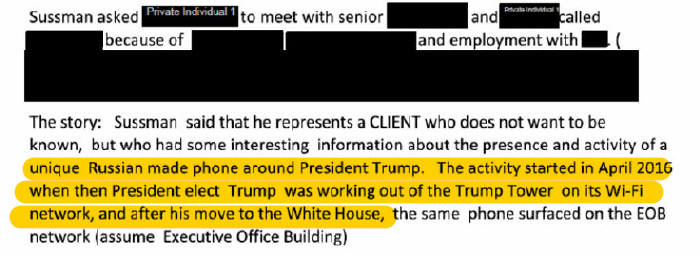
Durham provided to the Court two sets of notes related to Sussmann’s representations to the CIA. The first was from Sussmann’s January 31, 2017 contacts with a CIA employee where Sussmann discussed wanting to provide to the CIA data on “the presence and activity of a unique Russian made phone around President Trump.” It was said that this secret activity started in April 2016 and continued after Trump’s “move to the White House.”

5ed50b77-f64e-4aca-80c8-bfe3c6cfe5d5_700x264.png

Sussmann alleged the Russian phone (YotaPhone) was always close to Trump (“only around the President’s Movements”), surfacing at his Trump Tower Network in April 2016 and being used through Wi-Fi at Trump’s Grand Central West apartment. The phone even “appeared with Trump in Michigan” when he was interviewing a Cabinet Secretary.

799e9fae-ea08-48f9-b768-4f9174c1861e_714x160.png

At a minimum, this confirms what we reported nearly two months ago: that the Trump transition data was passed to the CIA. Yet it’s also more than that. The CIA was provided with data all the way back from April 2016.


The Reactionary is a reader-supported publication. To receive new posts and support my work, consider becoming a free or paid subscriber.


Why does April 2016 matter? Because Russia was alleged to have hacked “the Democratic Congressional Campaign Committee and DNC networks in April 2016.” Recall that “Crowdstrike was contacted on April 30, 2016 to respond to a suspected breach” of the DNC.


The CIA Notes Part 2: Sussmann’s February 9, 2017 meeting with the CIA


That January 31, 2017 conference was used to schedule the February 9, 2017 meeting with the CIA. At that meeting, Sussmann repeated his allegations that a “Russian-made Yota-phone” had been seen at Trump properties and had traveled with Trump to Michigan. He further alleged that “In December 2016, the Yota-phone was seen connecting to WIFI from the Executive Office of the President (the White House).”  

57424fff-71e3-41dc-841f-879efa6973c2_890x283.png

A brief but necessary aside: The Washington Post alleged us to have fanned “the flames” on the Sussmann/Joffe spying operation, taking us to task for stating (correctly): “They spied on Trump.” I hope the Washington Post is reading this, because the CIA notes confirm what we reported and what we told them via e-mail. Techno 1, WaPo 0.


Back to the Durham Filing – and the CIA’s analysis of the Sussmann/Joffe data.


The CIA reviewed the Trump/YotaPhone data (and the Alfa Bank data) in early 2017. The fact that the CIA accepted this data on President Trump is its own scandal. In any event, the CIA’s findings are significant, as they concluded that the data was not “technically plausible” and was “user created and not machine/tool generated.”

854f795c-d1a9-4d6a-a241-0a4f46c78103_746x395.png

(I’ve been asked about the last part of that paragraph, which says the “Special Counsel’s Office has not reached a definitive conclusion in this regard.” The term “definitive conclusion” stands out, making me suspect he has “initial” conclusions on the data. Durham’s filings in this case suggest he agrees with the CIA.)

Anyway, what a finding by the CIA. Of course, this only leads to more questions:

  1. Which “user” created the data? 
  2. Does it go back to the Joffe conspiracy? 
  3. And who else is part of that conspiracy? 

For that last question, consider this revelation from a previous Durham filing:

721f01a9-b96e-4277-9bb3-88319ff3c4b7_689x157.png

As to those questions of a conspiracy, Durham’s granting of immunity provides some insight. As we suspected back on April 5, “Researcher-2” (identified as David Dagon) has been given immunity. The reason? So that Durham can “uncover otherwise-unavailable facts” relating to the Alfa Bank project.

e68a8498-c250-4026-826e-959371b3660d_753x170.png

Dagon being granted immunity is certainly important, as Durham states that Rodney Joffe – who led the Alfa Bank hoax effort – remains a “subject” of the investigation. While Sussmann and others argue that it’s impossible to prosecute Joffe because of the 5-year statute of limitations, Durham disagrees, stating: “defense counsel is not – and could not be – aware of all the evidence that the Government has collected and continues to collect, or the possible violations of law it is investigating.”


Durham will also be granting immunity at trial “for an individual who was employed at” Fusion GPS. I initially suspected this was Christopher Steele but was steered in the right direction after some smart folks noted the person was “employed” at Fusion GPS (as opposed to Steele, who was “retained” by Fusion GPS). This person might be Laura Seago.

26381db5-ac71-4427-a4a1-e615e693425a_731x167.png

This former Fusion GPS employee will likely testify to “limited information pertaining to” Christopher Steele. As Durham puts it: this will include whether Sussmann was acting on behalf of the Clinton Campaign when he relayed the Alfa Bank allegations.

06868ff2-25e9-4290-a8b9-3d74af446655_719x233.png

Finally, I leave you with some questions to consider. Start asking why Sussmann and Joffe were so desperate to provide the FBI and CIA with dirt purportedly linking Trump and Russia. Sussmann himself provided false statements to federal officials, and it’s becoming more and more likely that someone potentially fabricated this evidence. Sussmann and Joffe risked charges - and thus jeopardized their lucrative careers - to tie Trump to Russia.

Considering the personal costs to both men, are we to believe that this was only about politics?


Or maybe this all leads back to the DNC hack…


The Reactionary is a reader-supported publication. To receive new posts and support my work, consider becoming a free or paid subscriber.

Sunday, April 10, 2022

Hillary Clinton’s treachery


America is still paying the price for Hillary Clinton’s treachery

Michael Goodwin, New York Post

However this era of angry polarization, crime and violence ends, it will be left to historians to decipher how America got so far off track. Instead of building on our unprecedented prosperity and role as the world’s ultimate superpower, we declared war — cultural, political and social — on each other. Even our nation’s Founders are not spared. 

The reasons will be better understood in hindsight, but it’s hard to believe the 2016 presidential campaign won’t be seen as an inflection point. Our move toward disunion didn’t begin then, but it certainly gained steam and vitriol during and after the election of Donald Trump. 

Two recent developments illustrate how that campaign remains a radioactive hot spot. With both developments centering on Hillary Clinton, they underscore her role and the depths of her venality. 

Just when you think you’ve seen the worst of her, proof emerges that she was even more duplicitous than we knew. 

The first evidence came in a little-noticed decision from the Federal Election Commission. It ruled on a complaint from the Coolidge Reagan Foundation that Clinton and the Democratic National Committee violated federal law by hiding how they funded the odious Christopher Steele dossier, perhaps the most destructive disinformation document in United States history. 

The FEC agreed with the complaint and ruled that Clinton and the DNC, which she effectively controlled, hid their payments to Steele as merely “legal fees,” without mentioning him or his work. In fact, the money was funneled through a law firm, Perkins Coie, which then hired the smear merchants at FusionGPS, who hired Steele, a former British spook. 

The layers and false claim about legal fees were intended to put distance between Clinton and Steele because knowledge of the truth would have destroyed her campaign. Although her lawyers and the DNC argued they did nothing wrong, they agreed not to contest the findings and quietly paid fines totaling $113,000. 

Press looks the other way 

If this effective admission on funding the dirtiest dirty trick in presidential politics is news to you, don’t blame yourself. Much of the media ignored or downplayed the finding and Clinton’s fine, saying the issue was just one of “misreporting” or “mislabeling” the Steele payments. 

That’s because the truth would make them look guilty, too. To report on the election commission’s significance would force the Dems’ propaganda arm to acknowledge its own culpability. 

By treating the Steele dossier as if it were holy writ, or at least credible, the media furthered Clinton’s campaign to paint Trump as a Russian stooge. 

Of course, the FBI was also complicit, using the dossier as a crutch to justify its unjustifiable spying on a presidential campaign. A remaining question is, under Jim Comey’s leadership, was the FBI the dumbest ever or the most venal? 

Probably both but whatever the answer, J. Edgar Hoover finally can rest in peace. 

The second recent development involves a new court filing by special counsel John Durham in the case of Michael Sussmann, a Clinton lawyer and campaign operative who is charged with lying to the FBI in 2016. His alleged role expands the deception annals by showing Clinton’s team wasn’t relying only on Steele’s farrago of lies, lies and more lies. 

Perhaps doubtful that Steele, even with his FBI friends and media contacts, could make up for her unpopularity, Clinton financed a bookend to his dossier with another fabrication. 

This second scam had Sussmann, a tech executive and the same smear merchants try to sell the FBI on a concocted story about a Trump computer secretly communicating with a Russian bank. 

Durham calls the effort a “joint venture” of the conspirators, a phrase that gives a sense of the plot and the players. There wasn’t a scintilla of truth to back up the computer nonsense, and even though the FBI saw through the tissue-thin claim, many in the media naturally fell for it. 

They managed to find in this particular lie a confirming detail of the larger lie Steele was spinning — that Trump was a toady of Vladimir Putin and was colluding with him to steal the election. 

Crime against democracy 

The case is a criminal one because Durham accuses Sussmann of lying by saying he was not representing any clients as he tried to spin a top agency official on the computer connection. In fact, Sussmann was representing the Clinton campaign, which he billed for the meeting, and the tech executive, identified as Rodney Joffe. 

Although Sussmann pleaded not guilty, Durham released a text message in which Sussmann explicitly tells the FBI he is not representing any clients. 

His trial, scheduled for next month, has the potential to be a breakthrough in Durham’s long-running effort to reveal voluminous wrongdoing by Clinton and the federal government against the Trump campaign. 

Based on his court filings, the prosecutor appears to be planning to link Sussmann’s efforts to the dossier, in part because of the role his firm, Perkins Coie, played in both scams. Also, Durham said Sussmann met with Steele and FusionGPS in Perkins Coie offices and raised the possibility that Steele could testify. 

Even before a verdict, the case moves the responsibility closer to where it ultimately belongs–in Clinton’s lap. Whether Durham will ever be able to show her fingerprints on any criminal conduct is the great unknown, but in one sense, it’s also beside the point. 

We already know with 100 percent certainty that she is guilty of igniting the false accusations of Russian collusion that continue to shape our culture and politics. Although Trump was hardly a model president, the widespread claim by her party and the media that he was an illegitimate president wasn’t just dirty politics. It was a nuclear attack on the spirit that has always held our nation together, however tenuously. 

Clinton lost the election and Robert Mueller’s special counsel probe came up empty, yet the collusion narrative lives on among major elements of the political left. To judge from the tumultuous years since, many of those who subscribe to her lie are using it as a license to try to destroy America. 

Tragically, they are having a good deal of success.

Do the crime, do lots of time 

Reader Steve Lounsberry, fearing that violence in New York is too entrenched to be reversed with halfway measures, offers what he admits is a “draconian” solution. He writes: “If you possess an illegal gun —

5 years in prison. Use an illegal gun in commission a crime — 10 years. Shoot someone in commission of a crime — 20 years. Kill someone in commission of a crime — life without parole.” 

He says “sentences should be mandatory with no plea bargaining” and adds: “I bet victims and family members would like the idea.”

Sickeningly familiar to the bad Cuo days

Amid a COVID outbreak, The Wall Street Journal reports from Hong Kong that “At least 20 patients died in recent weeks at the Donghai Elderly Care Hospital, according to members of several families.” 

Anybody see Andrew Cuomo lately?  

Saturday, April 02, 2022

Biden Runs Out of Gas


Biden Runs Out of Gas

Mathew Continetti, National Review

The president has an unerring instinct to make problems worse.

This is a wartime bridge to increase oil supply into production,” President Biden said during his announcement Thursday that he would release more barrels of oil from the nation’s Strategic Petroleum Reserve than at any point in American history. His decision was also a concession. None of the policies Biden has enacted throughout his short presidency have alleviated the problems they were meant to solve. Quite the opposite: In practically every case, Biden has made things worse.

Energy? Killing the Keystone pipeline was one of the first things Biden did when he took office. In February, Biden delayed approval of new oil and gas leases. He continues to blame the increase in gas prices on Vladimir Putin’s invasion of Ukraine, even though prices began to rise early in Biden’s term. Biden scapegoats oil companies for sitting on profits, while he could be doing everything in his power to ramp up domestic production of available fuel sources — including nuclear.

The fallout from Putin’s war was bound to make energy scarce and thus more valuable. Biden could have lessened the pain on the American consumer by pursuing an all-of-the-above energy dominance policy from the start, and by reducing the size of the American Rescue Plan so that it didn’t contribute to inflation. He chose to ignore the warnings of economists such as former Treasury secretary Lawrence Summers and followed his advisers who incorrectly predicted that inflation would be temporary. By turning to the Strategic Reserve, Biden is promoting a temporary fix while the long-term solutions are plain to see. He’s relied on similar gimmicks before. They haven’t worked.

Consider Biden’s immigration policy. He spent his early days as president tearing up President Trump’s agreements with Mexico and several Central American countries that forced asylum-seekers to stay in third-party nations while U.S. judges decided on their claims. The rush for the border was swift and ongoing. This week, Biden is expected to reverse a rule Trump enforced during the coronavirus pandemic that allowed border agents to repatriate illegal immigrants swiftly because of the public-health emergency. Homeland Security officials tell the New York Times that because of Biden’s decision they are planning on unauthorized crossings to double from an already high level. Republicans must be giddy with anticipation at the coming headlines.

Immigration and the border were the first places where you saw erosion in Biden’s job approval numbers last spring. Now he’s about to do something that will undermine border security and his political standing, and for no discernible reason. The pandemic is not over. Border crossings aren’t falling. We know that Biden’s decision will attract additional illegal immigrants. Nothing about this policy makes sense.

Biden doesn’t make sense. His Europe trip was a substantive success but a stylistic failure. The Western alliance is holding. But the president gaffed his way across Eastern Europe — saying the West would respond “in kind” to a Russian chemical attack, denying the deterrent value of sanctions when his subordinates have said precisely the opposite, telling U.S. troops that they would see the horrors of war in Ukraine firsthand, then raising the possibility that America’s strategic goal is regime change in Russia. Then, when Fox’s Peter Doocy soberly asked him about these inadvisable statements, Biden denied that he had said anything problematic.

I happen to believe that the world would be a safer place if Vladimir Putin were out of power — that indeed one possible consequence of a Russian defeat in Ukraine is Putin’s demise. I also believe that presidents shouldn’t sound like me. They need to watch their public statements because, as we were reminded throughout the Trump administration, words matter. Biden’s sentiment in Warsaw was correct. His sense of timing was wrong. After all, you never get in trouble for what you don’t say. Biden’s problem is that he rarely lets his actions speak louder than his words. And the words are garbled.

People notice. They don’t like what they hear, they can’t stand what they see. The public verdict on Biden is grim. He has not benefited from a rally-around-the-flag effect. His approval rating continues to fall. He’s at 41 percent approval in the FiveThirtyEight average of polls. He fell under 40 percent approval in this week’s Marist poll. Republicans continue to lead the congressional generic ballot. Democrats recognize that the electoral battlefield has widened. Biden is running out of time to improve his standing. And he hasn’t demonstrated an ability to bounce back as president.

Biden entered office at a time of national emergency. He benefited from the public’s desire to see Donald Trump off the airwaves for the first time in years. He oversaw the successful implementation of the vaccination program Trump had started. The resilience of the American economy helped him too.

Then the situation went sidewise. Biden’s problems started on the southern border, ramped up with the Delta variant of coronavirus, accelerated with inflation, spread with the debacle in Afghanistan, and haven’t abated since. His rallying of the West in support of Ukraine is laudable, but he still hasn’t done enough to help the Ukrainians, and he keeps stumbling on his own message. His commitments to the left wing of his party keep him from embracing the center. And damaging leaks about the federal investigation into his son’s finances only will mount if Republicans take Congress in November.

Biden’s reliance on the Strategic Petroleum Reserve is telling. This is a presidency that is running out of gas.


This column originally ran at the Washington Free Beacon.